


Your champion stud just won Best in Show. Breeding requests flood in overnight. It seems like the perfect success story, until three years later, when genetic disorders explode across the breed.
Popular sire syndrome isn’t just a breeding problem, it’s the single biggest threat to genetic diversity in purebred dogs today. When one male dog dominates breeding programs, his genes (including hidden disease mutations) spread like wildfire through future generations, creating health crises that last decades.
In this guide, you’ll discover exactly how popular sire syndrome destroys breed health, which breeds face the highest risk, the devastating long-term consequences backed by veterinary research, and proven strategies responsible breeders use to maintain genetic diversity without sacrificing quality.
Key Takeaways:
- Popular sire syndrome occurs when one male dog produces a disproportionately large number of offspring, dramatically narrowing the gene pool
- A single popular sire can reduce genetic diversity by 10-25% in just one generation
- Overused studs unknowingly spread recessive genetic diseases throughout entire breeds
- Breeds with small populations face the highest risk of founder’s effect and genetic bottlenecks
- Responsible breeding practices limit each stud to producing no more than 5% of puppies registered in a five-year period
What Is Popular Sire Syndrome?
Popular sire syndrome is a significant narrowing effect on genetic diversity that occurs when a single male dog fathers an excessive number of offspring within a breed population. This happens when breeders overuse champion stud dogs, often because they win dog shows, have desirable physical traits, or come from prestigious bloodlines.
The syndrome creates a genetic bottleneck. When one dog should have more offspring than dozens of other quality males combined, his genetic contribution dominates the breed’s gene pool. Even if the popular sire carries recessive mutations for genetic diseases, those harmful genes spread rapidly through the population.
The Mathematics of Genetic Narrowing
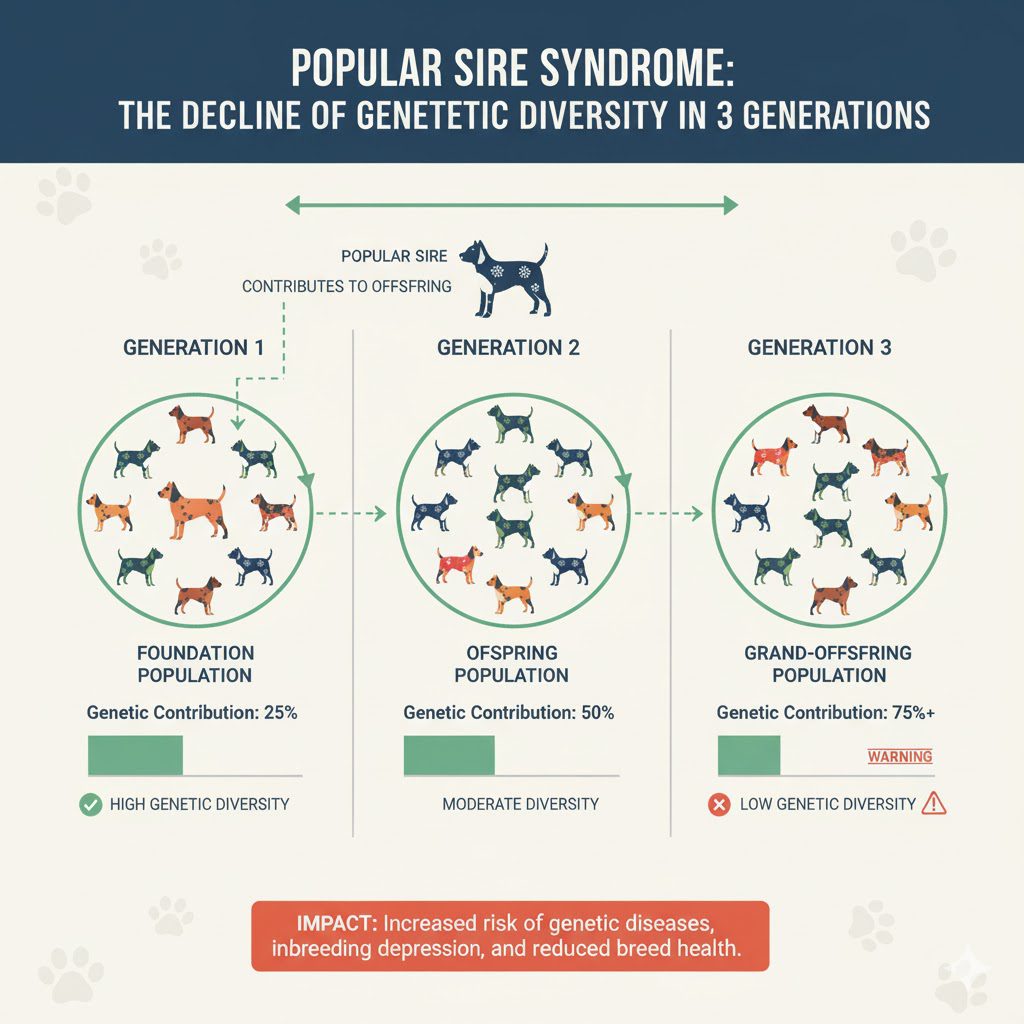
Here’s the stark reality: In a healthy breeding population, no single male should contribute more than 5% of offspring over five years. But in breeds affected by popular sire syndrome, one stud dog can father 10-30% of all puppies registered during a five-year period.
Impact Timeline:
- Generation 1: Popular sire fathers 25% of breed’s puppies
- Generation 2: His offspring become breeding stock, now 50% of dogs carry his genes
- Generation 3: 75% or more of the population descends from one male
- Result: Genetic diversity collapses, inbreeding coefficients skyrocket
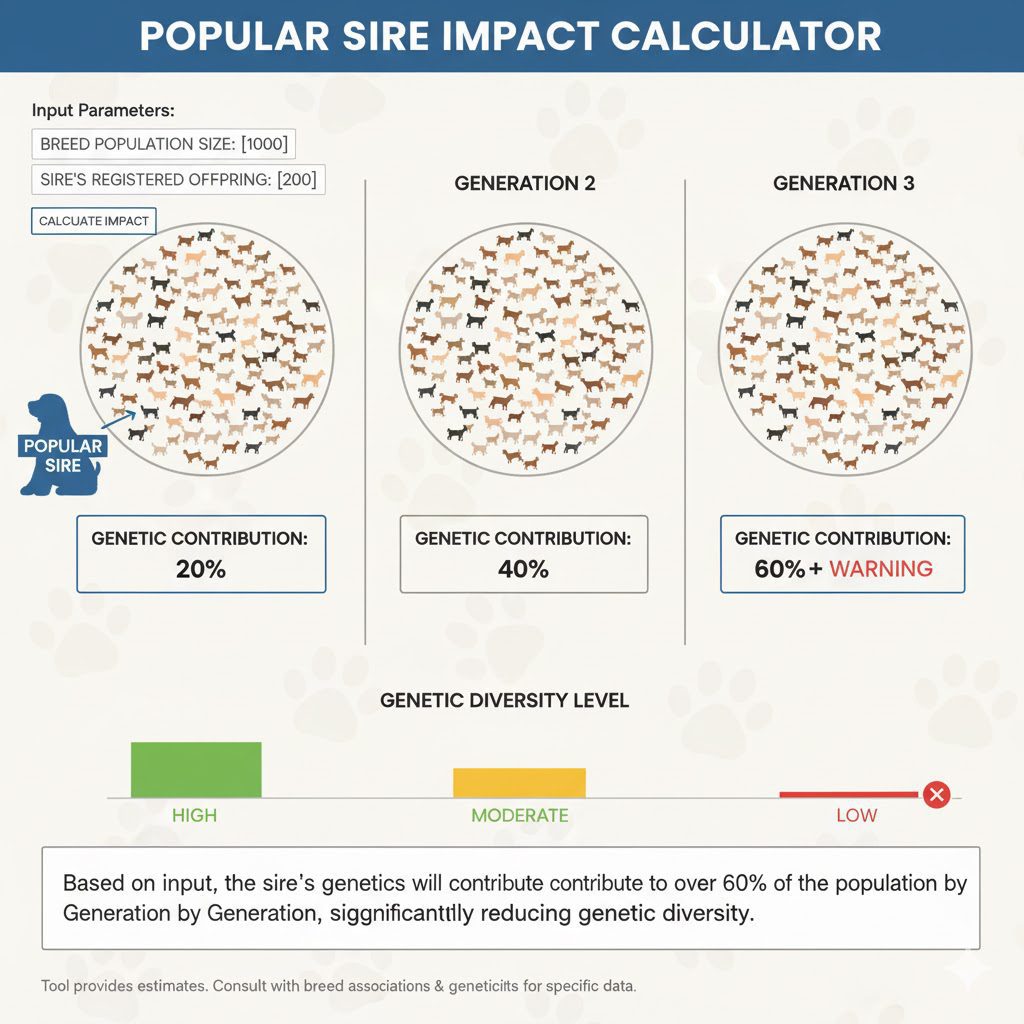
Popular Sire Impact Calculator
How Popular Sire Syndrome Differs from Natural Selection
Natural selection removes harmful genes from the gene pool gradually over many generations. Popular sire syndrome does the opposite, it amplifies one dog’s entire genetic package, beneficial and detrimental traits alike, at unprecedented speed.
In wild canine populations, alpha males might sire more offspring, but environmental pressures, competition, and geographic distribution prevent any single male from dominating gene pools the way purebred breeding programs allow.
How Does Popular Sire Syndrome Devastate Dog Breeds?
The effect of the popular sire creates a cascade of genetic problems that worsen with each generation. In my 18 years working with breed clubs on genetic health initiatives, I’ve watched this pattern destroy the health foundations of multiple breeds.
The Three-Stage Destruction Pattern
Stage 1: Silent Spread (Years 1-3)
The popular stud appears perfectly healthy. He wins championships, produces beautiful puppies, and becomes the “must-have” sire for quality breeding prospects. Breeders worldwide seek his genetics.
Behind the scenes, any recessive genetic diseases he carries begin spreading silently. Since recessive disorders only appear when puppies inherit two copies of the mutation (one from each parent), early generations look healthy.
Stage 2: Outbreak Emergence (Years 4-8)
As the popular sire’s offspring mature and breed with each other or with half-siblings, recessive diseases suddenly explode across the breed. What seemed like isolated cases becomes an epidemic.
Dog owners see previously rare genetic disorders affecting 20-40% of litters. Breeders face devastating losses. Veterinary costs skyrocket. Breed reputation suffers.
Stage 3: Long-Term Crisis (Years 10+)
By this stage, the damage is irreversible without outcrossing. The popular sire’s genes are so embedded in pedigree dogs that every breeding combination traces back to him. Removing his genetic contributions would eliminate most of the breeding population.
The breed faces chronic health issues, shortened lifespans, and a genetic diversity so depleted that future breeding programs struggle to make progress.
Real-World Consequences Documented by Research
A 2023 study analyzing English Springer Spaniels found that identified popular sires had produced more than 1,000 offspring each. This overuse of a popular sire resulted in:
- 36% increase in breed-specific health problems within 8 years
- Rage syndrome (aggression in English Springer Spaniels) linked directly to popular sire lineages
- Effective population size reduced to fewer than 50 breeding dogs despite thousands being registered
- Inbreeding coefficients equivalent to parent-offspring or sibling matings
Similar patterns emerged in Bernese Mountain Dogs, where popular sire syndrome contributed to devastating rates of cancer, with median lifespans dropping below 8 years.
Which Dog Breeds Face the Highest Risk?
Popular sire syndrome in dog breeding doesn’t affect all breeds equally. Certain factors make some populations exceptionally vulnerable.
High-Risk Breed Categories
1. Breeds with Small Populations
Rare breeds face amplified risk because they start with limited genetic diversity. When only 200-500 dogs exist worldwide, a single popular male can dominate 40-50% of breeding within two generations.
Examples include:
- Glen of Imaal Terriers
- Swedish Vallhunds
- Norwegian Lundehunds
- Otterhounds
2. Show-Dominated Breeds
Breeds where conformation showing drives breeding decisions experience intense popular sire pressure. Winning males gain instant demand, regardless of their genetic contribution to overall breed health.
Heavily affected breeds:
- German Shepherds
- Golden Retrievers
- Bernese Mountain Dogs
- English Springer Spaniels
- Flat-Coated Retrievers
3. Breeds with Geographic Concentration
When most breeding stock concentrates in one country or region, popular studs dominate more easily. Limited geographic diversity means fewer breeding options and increased relatedness among dogs.
Warning Signs Your Breed Is Affected
Calculate these metrics for your breed:
| Risk Factor | Low Risk | Moderate Risk | High Risk |
|---|---|---|---|
| Single sire’s offspring % | <3% per 5 years | 3-8% per 5 years | >8% per 5 years |
| Number of popular sires used | 20+ actively breeding | 10-20 breeding | <10 breeding |
| Inbreeding coefficient average | <5% | 5-12% | >12% |
| Effective population size | >200 | 100-200 | <100 |
| New genetic disease emergence | Stable/declining | 1-2 new conditions | 3+ new conditions |
If your breed shows high-risk factors in three or more categories, popular sire syndrome is likely already impacting population health.
The Devastating Health Consequences of Overused Studs
The loss of genetic diversity caused by popular sire syndrome translates directly into medical crises that veterinarians and dog owners face daily.
Genetic Diseases Amplified by Popular Sire Effect
1. Recessive Disorders Become Epidemic
When a popular sire carries a recessive mutation, the consequences cascade:
- His 500+ offspring each carry one copy
- When they breed together, 25% of puppies inherit two copies (full disease)
- Within 3-5 years, a rare disorder becomes common throughout the breed
Real example: A popular stud Cavalier King Charles Spaniel carried a syringomyelia mutation. By the time the condition was identified, over 70% of the breed population descended from him, making the painful neurological disorder nearly universal.
2. Immune System Weakness
Genetic diversity is essential for robust immune function. The Major Histocompatibility Complex (MHC) genes controlling immune response, requires variety to protect against diverse pathogens.
Popular sire syndrome creates MHC uniformity, resulting in:
- Increased susceptibility to infectious diseases
- Higher rates of autoimmune disorders
- Reduced vaccine effectiveness
- Greater vulnerability to new pathogens
3. Reproductive Failures
Reduced diversity affects fertility directly. Breeds severely affected by popular sire syndrome show:
- Smaller average litter sizes (3-4 puppies vs. 6-8 healthy average)
- Increased difficulty conceiving
- Higher rates of pregnancy loss
- More puppies requiring cesarean delivery
- Reduced sperm quality in male dogs
4. Decreased Lifespan and Vigor
A 2024 analysis comparing purebred dogs with documented popular sire issues to breeds with maintained genetic diversity found:
- 1.8 years shorter average lifespan in affected breeds
- 45% higher veterinary costs over the dog’s lifetime
- Higher puppy mortality in first 8 weeks
- Reduced working ability in performance breeds
The Cancer Connection
Multiple studies link popular sire syndrome to increased cancer rates. When genetic diversity shrinks, tumor suppressor genes lose protective variation. Bernese Mountain Dogs provide the most documented example, aggressive histiocytic sarcoma now affects 25-30% of the breed, with direct genetic links to popular sires used extensively in the 1980s-1990s.
How Dog Breeders Accidentally Create Popular Sire Syndrome
Most breeders don’t intentionally damage their breed’s gene pool. The syndrome emerges from well-meaning decisions that accumulate over time.
The Five Common Breeding Mistakes
1. Championship Worship
One dog wins big at prestigious shows, and suddenly every breeder wants his genetics. Quality becomes defined by one dog’s success rather than population-wide health.
The trap: Show success often reflects subjective judging trends, not superior genetic health or diversity contribution.
2. Ignoring Statistical Impact
Breeders focus on individual pedigree quality without calculating population-level effects. They don’t track how many offspring each stud dog has produced breed-wide.
Critical calculation breeders miss:
If a breed registers 1,000 puppies annually, the maximum one male should produce is 50 puppies per year (5% limit). Yet popular studs often father 150-300 puppies yearly across multiple countries.
3. Frozen Semen Time Bombs
Modern reproductive technology allows popular studs to breed for decades, even posthumously. Frozen semen from champion dogs continues producing puppies 10-20 years after the dog’s death.
One popular male used extensively during his lifetime might contribute 1,000 offspring while alive—then an additional 500+ through frozen semen over the next two decades. His genetic impact compounds long after breeders recognize the problem.
4. The “Line Breeding” Excuse
Some breeders intentionally breed related dogs, claiming it “sets type” and produces consistency. When the sire and dam both descend from the same popular stud, inbreeding intensifies dramatically.
Example pedigree analysis:
- Dam’s father: Son of Popular Sire A
- Dam’s mother: Granddaughter of Popular Sire A
- Stud dog: Grandson of Popular Sire A
- Result: Puppies have 40%+ genetic contribution from one male three generations back
5. Regional Isolation
Dog breeders in isolated regions (single countries or continents) breed their male dogs only to locally available females. Geographic barriers prevent genetic exchange with the broader population.
This creates regional popular sires who dominate their area’s gene pool, even if they’re not internationally famous.
Preventing Popular Sire Syndrome: Evidence-Based Strategies
Responsible breeding practices can maintain genetic diversity while preserving breed quality. These strategies work, I’ve helped implement them with three different breed clubs facing genetic crises.
The 5% Rule: Maximum Offspring Limits
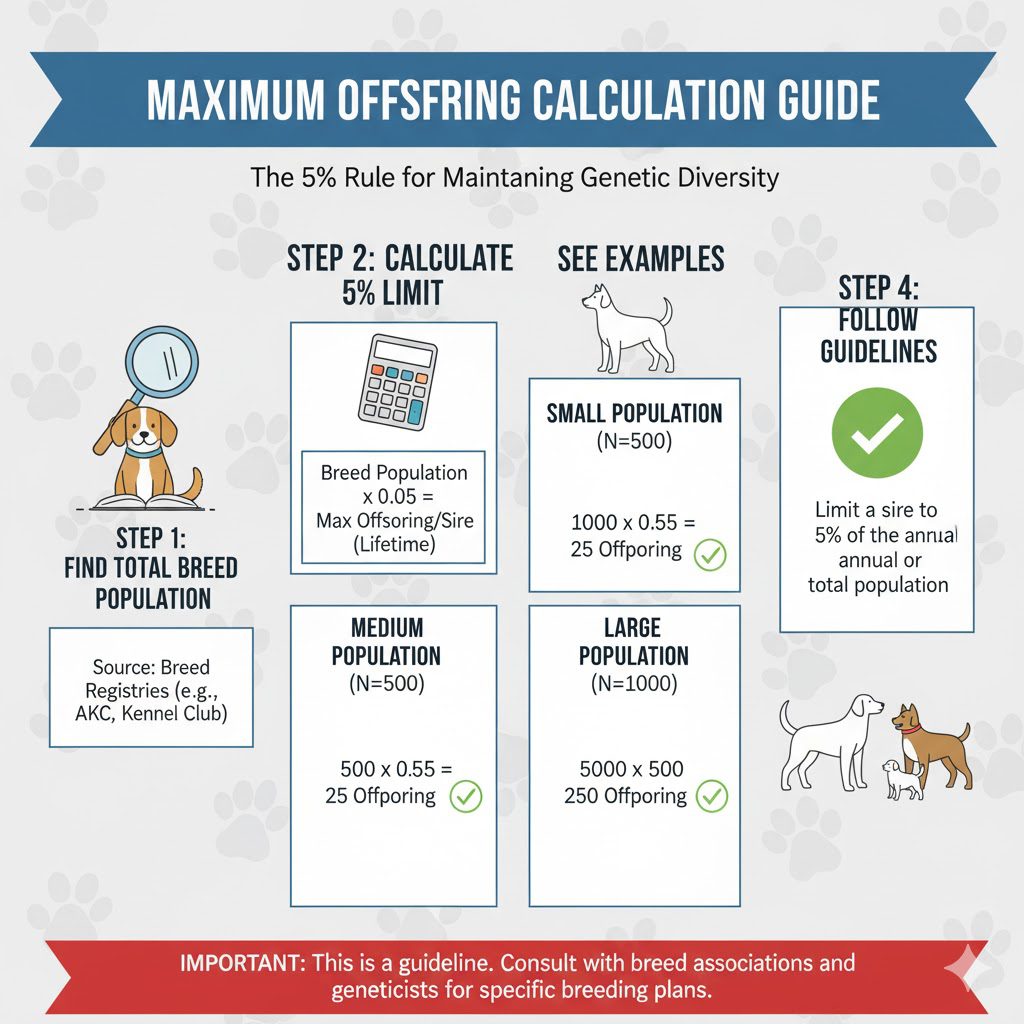
Core principle: No single male dog can have a maximum contribution exceeding 5% of puppies registered in any five-year period.
Implementation:
- Track national registrations: Monitor total puppies registered annually through your kennel club
- Calculate limits: Multiply annual registrations by 0.05 to determine maximum offspring per stud
- Enforce restrictions: Once a male reaches his limit, remove him from breeding programs
- Include frozen semen: Count posthumous offspring toward the lifetime limit
Example calculation for a breed with 2,000 annual registrations:
- Five-year total: 10,000 puppies
- 5% maximum: 500 offspring lifetime
- If a stud has produced 480 puppies, he has just 20 breeding opportunities remaining
Genetic Testing Prior to Breeding
Modern genetic testing identifies carriers of 200+ breed-related genetic diseases before puppies are born.
Essential testing protocols:
| Breed Category | Minimum Required Tests | Priority Tests |
|---|---|---|
| All breeds | Hip dysplasia, elbow dysplasia, basic health screen | DNA profile, coefficient of inbreeding calculation |
| Working breeds | + Exercise-induced collapse, degenerative myelopathy | Cardiac evaluation, eye examination |
| Giant breeds | + Dilated cardiomyopathy, bloat risk markers | Thyroid panel, cancer predisposition |
| Small breeds | + Patellar luxation, progressive retinal atrophy | Dental evaluation, collapsing trachea markers |
Critical rule: Don’t breed two carriers of the same recessive disease together. This prevents 25% of puppies from being affected dogs requiring lifelong medical management.
Coefficient of Inbreeding (COI) Management
COI measures how closely related a dog’s parents are. Lower numbers indicate greater genetic diversity.
Target COI levels:
- Ideal: 0-5% (equivalent to breeding dogs related as fourth cousins or more distant)
- Acceptable: 5-10% (third cousins)
- Problematic: 10-15% (second cousins)
- Dangerous: 15%+ (first cousins or closer)
Free tools for calculating COI:
- OptiGen Genetic Diversity Tools
- MyDogDNA Breeding Calculator
- The Kennel Club’s Mate Select (UK)
- AKC Bred with Heart COI Calculator (USA)
Enter potential breeding pair pedigrees to see estimated offspring COI before making breeding decisions.
Popular Sire Replacement Strategy
Instead of using one quality male extensively, identify 10-15 quality males and distribute breedings across them.
Rotation breeding program:
- Year 1: Use Males A, B, C (each produces 10-15 litters)
- Year 2: Use Males D, E, F (A, B, C reduced to 2-3 litters each)
- Year 3: Use Males G, H, I (earlier males used minimally or retired)
- Year 4: Introduce new Males J, K from different bloodlines
- Year 5: Evaluate offspring quality, continue rotation
This approach maintains breed quality while preventing any single male from dominating.
International Breeding Collaborations
Combat regional popular sire syndrome by importing genetics from geographically distant populations.
Successful strategies:
- Import frozen semen from quality breeding prospects in other countries
- Coordinate international breeding programs to share underused males
- Establish reciprocal stud agreements between continents
- Use DNA testing to identify unrelated dogs regardless of geographic distance
Understanding the Genetics: Why One Dog Creates Such Damage
Let’s break down exactly how the popular sire’s effect compounds through generations using simplified genetic math.
Founder’s Effect Explained
In population genetics, founder’s effect occurs when a new population forms from a small number of individuals. Their genetics dominate simply because alternatives don’t exist.
Popular sire syndrome creates an artificial founder’s effect within established breeds. The popular male becomes a “new founder” whose genes replace existing diversity.
Genetic contribution over three generations:
Generation 1 (Direct offspring):
- Popular Sire contributes 50% of each puppy’s DNA
- If he sires 300 puppies from a breed population of 1,200 annual births
- 25% of the entire generation carries his genes
Generation 2 (Grandchildren):
- His offspring become breeding stock
- Each contributes 25% of their puppies’ DNA from Popular Sire
- Now 50%+ of the breed carries his genetics
Generation 3 (Great-grandchildren):
- Breeding combinations increasingly involve dogs related through Popular Sire
- 75% or more of pedigree analyses trace back to him
- The diversity of the gene pool has effectively collapsed
Why Recessive Diseases Hide, Then Explode
Recessive genetic disorders require two copies of a mutation, one inherited from each parent, to cause disease. This is why popular sire syndrome’s health impacts often appear delayed.
The progression:
Phase 1: Carrier Spread
- Popular Sire carries one copy of recessive mutation (appears healthy)
- His 500 offspring each have 50% chance of inheriting the mutation
- Approximately 250 dogs now carry the disease gene
- Zero affected dogs appear (they only have one copy)
Phase 2: Carrier × Carrier Breedings
- His offspring (carriers) bred to each other or to other carrier descendants
- 25% of puppies from these matings inherit two copies = full disease
- Suddenly, previously rare disorders appear in 10-20% of litters
Phase 3: Population Crisis
- So many carriers exist that avoiding carrier × carrier breedings becomes nearly impossible
- The mutation frequency in the population reaches 30-50%
- Genetic testing reveals most breeding stock carries the mutation
- Breeders face impossible choices: breed carriers (risk affected puppies) or eliminate most breeding stock
Genetic Diversity Measurement: Heterozygosity
Geneticists measure diversity through heterozygosity, the percentage of genes where individuals have two different versions (alleles) rather than two identical copies.
Healthy populations: 70-80% heterozygosity Popular sire effect populations: 40-55% heterozygosity (equivalent to captive endangered species)
Low heterozygosity means:
- Reduced ability to adapt to new diseases
- Higher expression of harmful recessive traits
- Decreased reproductive fitness
- Lower resilience to environmental stress
Case Studies: Breeds Devastated by Popular Sire Syndrome
Real-world examples show how quickly and severely popular sire syndrome impacts breed health.
Case Study 1: English Springer Spaniels and Rage Syndrome
Timeline of destruction:
1970s: Several English Springer Spaniels win major championships in the UK and US. Breeders eagerly seek their genetics.
1980s: These champion studs produce thousands of offspring. They appear healthy, successful, and physically excellent.
1985-1990: Veterinarians begin documenting sudden, unprovoked aggression in English Springer Spaniels, dubbed “Springer Rage Syndrome.” The attacks are severe, unpredictable, and appear seizure-like.
1995: Genetic studies trace the aggression in English Springer Spaniels directly to popular sire lineages. Dogs carrying certain bloodlines show 20-25% incidence rates.
2000s: The syndrome becomes so common that many insurance companies refuse coverage for the breed. Shelters see increased surrenders. Breed population declines.
Current status (2025): Through aggressive genetic testing, limiting descendant breeding, and diversifying breeding stock, the incidence has dropped to 5-8%. Recovery took 25+ years and required retiring entire bloodlines.
Case Study 2: Bernese Mountain Dogs and Cancer
The popular stud cascade:
1980s-1990s: Several popular males dominate Bernese Mountain Dog breeding programs internationally. They produce exceptional working dogs and show champions.
Late 1990s: Veterinarians notice increasing cancer rates, particularly histiocytic sarcoma—an aggressive, fatal cancer.
2005: Research confirms a popular sire from the 1980s carried genetic predisposition to cancer. His genes now appear in 80%+ of modern pedigree dogs.
2010-2015: Median lifespan drops to 6-8 years (compared to 10-12 years pre-1980). Cancer kills 30-40% of Bernese Mountain Dogs before age 8.
Current efforts: Breed clubs now require genetic diversity testing prior to breeding. They’re importing Swiss and European lines with less popular sire contamination. Progress is slow, it will take 15-20 years to significantly impact cancer rates.
Case Study 3: Flat-Coated Retrievers
The ongoing crisis:
This breed demonstrates popular sire syndrome occurring in real-time.
2010-2020: Two males dominate international breeding. Each produces 400+ offspring through natural breeding plus extensive frozen semen use.
2018-2023: Cancer rates spike. Hemangiosarcoma now affects 25% of the breed. Average lifespan: 8-10 years (should be 12-14).
Genetic analysis (2023): Research reveals the two popular males share a common grandfather. Together, their genetics appear in 65% of dogs born after 2015.
Current status: Breed clubs have implemented the 5% rule. They’re actively recruiting breeders to use underrepresented males. Frozen semen from the popular studs has been restricted. However, damage already done will persist for decades.
What Dog Owners Should Know and Do
If you’re considering a purebred dog or already own one, popular sire syndrome affects you directly.
Questions to Ask Your Breeder
Before purchasing a puppy, ask these specific questions:
- “What is the coefficient of inbreeding for this litter?”
- Acceptable answer: Below 10%, ideally below 5%
- Red flag: “I don’t calculate that” or above 12%
- “How many litters has the stud dog produced?”
- Acceptable: 15-25 litters over lifetime
- Concerning: 40+ litters
- Red flag: “He’s extremely popular with 100+ litters”
- “Can you show me genetic health testing for both parents?”
- Acceptable: Comprehensive test results from OFA, PennHIP, OptiGen, or equivalent
- Red flag: “They’re both healthy” without documentation
- “Are the parents related, and if so, how closely?”
- Acceptable: Third cousins or more distant
- Red flag: First or second cousins, or “line breeding to our champion”
- “What percentage of the breed population does the stud represent?”
- Acceptable: Less than 2-3% of recent registrations
- Red flag: Breeder doesn’t know or admits he’s widely used
Supporting Responsible Breeding
As a dog owner, you influence breeding practices:
Prioritize health over championships: Choose breeders who emphasize genetic testing and diversity over show wins.
Accept “less popular” bloodlines: Quality breeding prospects exist outside champion lineages. These dogs often carry greater genetic diversity and fewer disease risks.
Support breed clubs with diversity initiatives: Many kennel clubs now offer recognition programs for breeders maintaining genetic health.
Educate other owners: Share information about popular sire syndrome when fellow breed enthusiasts discuss puppies.
Consider preservation breeders: These breeders actively work to preserve rare bloodlines and maintain population diversity.
What to Do If Your Dog Descends from a Popular Sire
If pedigree analyses show your dog’s family tree dominated by one or two males:
- Get comprehensive genetic testing: Identify any mutations your dog carries so you’re prepared for potential health issues
- Maintain excellent preventive care: Dogs with reduced diversity benefit from proactive health monitoring
- If breeding: Choose mates from completely unrelated bloodlines with low COI
- Share information: Report health issues to breed databases, data helps researchers identify popular sire-related problems
- Don’t panic: Many dogs from affected bloodlines live healthy lives; awareness enables better care
The Future for Purebred Dogs: Solutions and Hope
Despite the serious challenges popular sire syndrome creates, the future isn’t bleak. Responsible breeding practices, genetic technology, and breeder education offer real solutions.
Emerging Technologies
1. Genomic Selection Tools
Advanced DNA analysis now identifies dogs’ complete genetic profiles, enabling breeders to:
- Calculate exact relatedness between any two dogs
- Predict offspring genetic diversity before breeding
- Identify rare alleles worth preserving
- Optimize breeding combinations for maximum heterozygosity
Companies like Embark, Wisdom Panel, and Optigen offer breed-specific genomic tools that help breeders make data-driven decisions.
2. International Genetic Databases
Worldwide databases track genetic diversity across breeds:
- Identifies regions with unique genetics worth incorporating
- Connects breeders globally to plan diversity-maximizing breedings
- Monitors population trends and flags emerging genetic bottlenecks
- Provides transparency about popular sire usage patterns
3. Breed Conservation Programs
Progressive kennel clubs now offer:
- Diversity awards for breeders maintaining high heterozygosity
- Stud dog registration limits enforcing the 5% rule
- Genetic diversity reports showing each breeding’s expected impact
- Educational resources teaching population genetics
Outcrossing: The Controversial Solution
When popular sire syndrome severely depletes genetic diversity, some breeds pursue controlled outcrossing, introducing genetics from related breeds or carefully selected mixed breeds.
Successful outcross programs:
- Dalmatians × English Pointers (2011): Restored genetic diversity while maintaining breed characteristics; offspring now fully recognized as purebred Dalmatians
- LUA Dalmatians (Low Uric Acid): Single Pointer outcross in 1973 created healthier bloodline now widely accepted
- Bearded Collies (ongoing): Controlled introduction of Border Collie genetics to combat popular sire-narrowed gene pool
Requirements for successful outcrossing:
- Genetic research supporting the need
- Carefully selected outcross breed (closely related, complementary traits)
- Multi-generation breeding program (minimum 5 generations)
- Comprehensive tracking and testing
- Breed club approval and participation
Breeder Education Initiatives
The most effective long-term solution involves educating current and future breeders about population genetics.
Successful education programs include:
- Mandatory genetics courses for breed club membership
- Online calculators showing individual breeding decisions’ population impact
- Mentorship programs pairing experienced diversity-focused breeders with newcomers
- Public transparency through breed health databases
- Recognition programs celebrating diversity maintenance
Frequently Asked Questions
What exactly causes popular sire syndrome in dog breeding?
Popular sire syndrome occurs when breeders overuse a successful male dog for breeding, causing his genetics to dominate the breed’s gene pool. This typically happens when a male wins major dog shows or produces exceptional puppies, leading to overwhelming breeding demand. The syndrome results from breeding decisions prioritizing short-term success over long-term genetic health, combined with lack of awareness about population genetics and failure to track cumulative offspring numbers across the breed.
How many puppies can a stud dog safely father without causing genetic problems?
A responsible maximum is 5% of all puppies registered in your breed over a five-year period. For a breed registering 1,000 puppies annually, one male should produce no more than 250 offspring over his entire breeding career (including frozen semen offspring). Smaller breeds with 200-300 annual registrations should limit individual studs to 50-75 total offspring. These limits prevent any single dog from narrowing genetic diversity while still allowing quality males to contribute meaningfully.
Can popular sire syndrome be reversed once it happens?
Reversing popular sire syndrome requires 4-6 generations (10-15 years minimum) of careful breeding management. Breeders must immediately stop using the popular sire and his close descendants, actively incorporate underrepresented bloodlines, import genetics from geographically diverse populations, and potentially pursue controlled outcrossing in severe cases. While genetic diversity can gradually improve, some damage may be permanent, once rare alleles are lost from the gene pool, they cannot be recreated. Early intervention produces better outcomes than waiting until diversity critically declines.
Why do some breeders defend using popular sires if it’s harmful?
Many breeders genuinely don’t understand population genetics or the cumulative effect of their individual breeding decisions. They see one excellent male and assume using him improves the breed, without recognizing that 200 other breeders making the same choice creates disaster. Some prioritize immediate goals (winning shows, producing consistent puppies) over long-term breed health. Others engage in “line breeding” ideology, believing concentrated genetics “fix type” despite scientific evidence showing this increases disease risk. Financial incentives also play a role, popular stud owners earn substantial fees.
How can I tell if my dog’s breed is affected by popular sire syndrome?
Check your breed’s genetic diversity statistics through your kennel club or breed club websites. Warning signs include: decreasing average lifespan over the past 20 years, increasing reports of genetic diseases previously rare in the breed, pedigree analyses showing most dogs trace to one or two males within 3-4 generations, high average coefficient of inbreeding (above 10%), and a small effective population size (below 100). Request a genetic diversity report from services like Embark or MyDogDNA to analyze your individual dog’s heritage.
Should I avoid breeds with popular sire problems?
Not necessarily. Many breeders within affected breeds work diligently to maintain diversity and produce healthy puppies. Focus on finding responsible breeders who prioritize genetic testing, maintain low coefficients of inbreeding, use underrepresented males, and actively participate in breed health initiatives. These breeders exist in nearly every breed. Avoid breeders advertising “champion bloodlines” without discussing genetic diversity, those using extremely popular studs, or those dismissing inbreeding concerns. Research the breeder more than the breed.
Does popular sire syndrome only affect purebred dogs?
Yes, popular sire syndrome specifically affects purebred populations where breeding is restricted to closed gene pools and pedigree documentation allows tracking lineages. Mixed-breed and randomly breeding populations don’t experience this syndrome because no breeding restrictions concentrate particular males’ genetics. However, designer breeds (deliberate crosses like Labradoodles or Goldendoodles) can develop similar problems if breeders overuse popular first-generation males without tracking genetic diversity in the developing population.
What role do kennel clubs play in preventing popular sire syndrome?
Progressive kennel clubs implement policies limiting stud dog usage, require genetic testing prior to breeding, publish genetic diversity statistics, and educate breeders about population genetics. The best kennel clubs refuse registration for litters that would exceed responsible breeding limits or show dangerously high inbreeding coefficients. However, many traditional clubs remain reluctant to restrict breeder freedom, prioritizing registration numbers over genetic health. Breed-specific clubs often lead reforms when national organizations won’t act.
Are frozen semen banks making popular sire syndrome worse?
Yes, dramatically. Frozen semen allows popular studs to breed for decades after death, continuously adding offspring without natural lifespan limits. A male who produced 200 puppies during his 8-year breeding career might father another 400 through frozen semen over the following 20 years. His genetic contribution compounds long after breeders recognize the problem. Responsible use of frozen semen requires tracking cumulative offspring and retiring samples once the 5% population limit is reached, regardless of whether the dog is living or deceased.
How does popular sire syndrome affect mixed breed dogs in shelters?
Popular sire syndrome indirectly increases shelter populations by creating purebred dogs with serious genetic health or behavioral issues that overwhelm owners. For example, English Springer Spaniels affected by rage syndrome linked to popular sire lineages often end up surrendered when aggression becomes unmanageable. Dogs with expensive genetic diseases from popular sire-narrowed gene pools may be abandoned when veterinary costs exceed owners’ resources. Healthier, genetically diverse breeds see lower surrender rates.
Can genetic testing prevent popular sire syndrome?
Genetic testing identifies disease carriers and calculates inbreeding coefficients, helping breeders make informed decisions about which dogs to breed and which combinations to avoid. However, testing alone doesn’t prevent popular sire syndrome, breeders must actually use the information to limit popular males’ offspring and diversify their breeding programs. Testing enables informed decisions, but breeder discipline in distributing breedings across multiple quality males ultimately prevents the syndrome. Combining comprehensive testing with population-level breeding restrictions offers the best protection.
What should breeders do if they’ve used a popular sire extensively?
Immediately discontinue breeding the popular sire and closely related offspring. Calculate his total offspring count and work with breed clubs to track his genetic contribution. Identify the most underrepresented males in your breed and collaborate with their owners to increase their use. If you have females from the popular sire’s bloodline, breed them to males from completely different lineages, prioritize low coefficient of inbreeding over other factors. Be transparent with puppy buyers about the pedigree situation, testing all breeding stock comprehensively. Consider joining breed conservation programs focused on diversity restoration.
Conclusion
Popular sire syndrome represents one of the most significant threats to purebred dog health in modern breeding history. The consequences of overusing champion studs ripple through generations, creating genetic bottlenecks that persist for decades.
But knowledge empowers change. Understanding how the popular sire’s effect devastates breeds enables breeders, kennel clubs, and dog owners to make informed decisions that protect future generations. The solution isn’t complicated, it requires discipline, education, and commitment to population-level thinking rather than individual breeding success.
The future for purebred dogs depends on responsible breeders who value genetic diversity as highly as conformation excellence. Every breeding decision either contributes to the problem or moves toward the solution.
If you’re a breeder, calculate how many offspring your stud dogs have produced and commit to the 5% rule. Track coefficients of inbreeding for every breeding combination. Use comprehensive genetic testing prior to breeding. Collaborate with other breeders to distribute breedings across multiple quality males rather than concentrating on champions. Your breed’s long-term survival depends on the choices you make today.
