


Your German Shepherd’s movement, health, and working ability depend entirely on one thing: correct anatomical structure. The German Shepherd Dog (GSD) is a medium-size breed specifically engineered for endurance trotting, every angle, bone length, and muscle placement serves this purpose.
Understanding GSD anatomy isn’t just for show ring judges or breeders. Whether you’re evaluating a puppy, maintaining your adult dog’s health, or simply appreciating what makes this breed exceptional, knowing how a German Shepherd should be built helps you make better decisions about breeding, training, and veterinary care.
Key Takeaways:
- The German Shepherd’s skeletal structure is designed for efficient, tireless trotting with specific angulation requirements
- Height at the withers should be 60-65 cm for males and 55-60 cm for females, with bodies slightly longer than tall
- Correct front and rear angulation creates the breed’s characteristic “flying trot” and prevents orthopedic problems
- The topline (back) should have a slight slope from withers to croup without excessive angulation
- Understanding anatomy helps identify structural faults that impact working ability and long-term health
What Is German Shepherd Dog Anatomy?
German Shepherd Dog anatomy refers to the breed’s skeletal structure, muscle placement, and physical proportions as defined by the breed standard established by the Verein für Deutsche Schäferhunde (SV) and recognized by kennel clubs worldwide. This trotting dog breed requires specific angulation, bone length ratios, and muscular development to perform its original herding and working functions efficiently.
The GSD’s anatomy is fundamentally different from other breeds. Where most dogs are built for sprinting or casual movement, the German Shepherd’s structure prioritizes sustained trotting, covering maximum ground with minimum energy expenditure. Every anatomical feature, from the slightly elongated body to the specific shoulder blade angle, contributes to this efficiency.
Captain Max von Stephanitz, who founded the breed in 1899, selected dogs not for appearance but for working ability. The anatomy we see today reflects over a century of breeding for function, though modern show lines have diverged from the original working-line structure in concerning ways.
The Foundation: Skeletal Framework
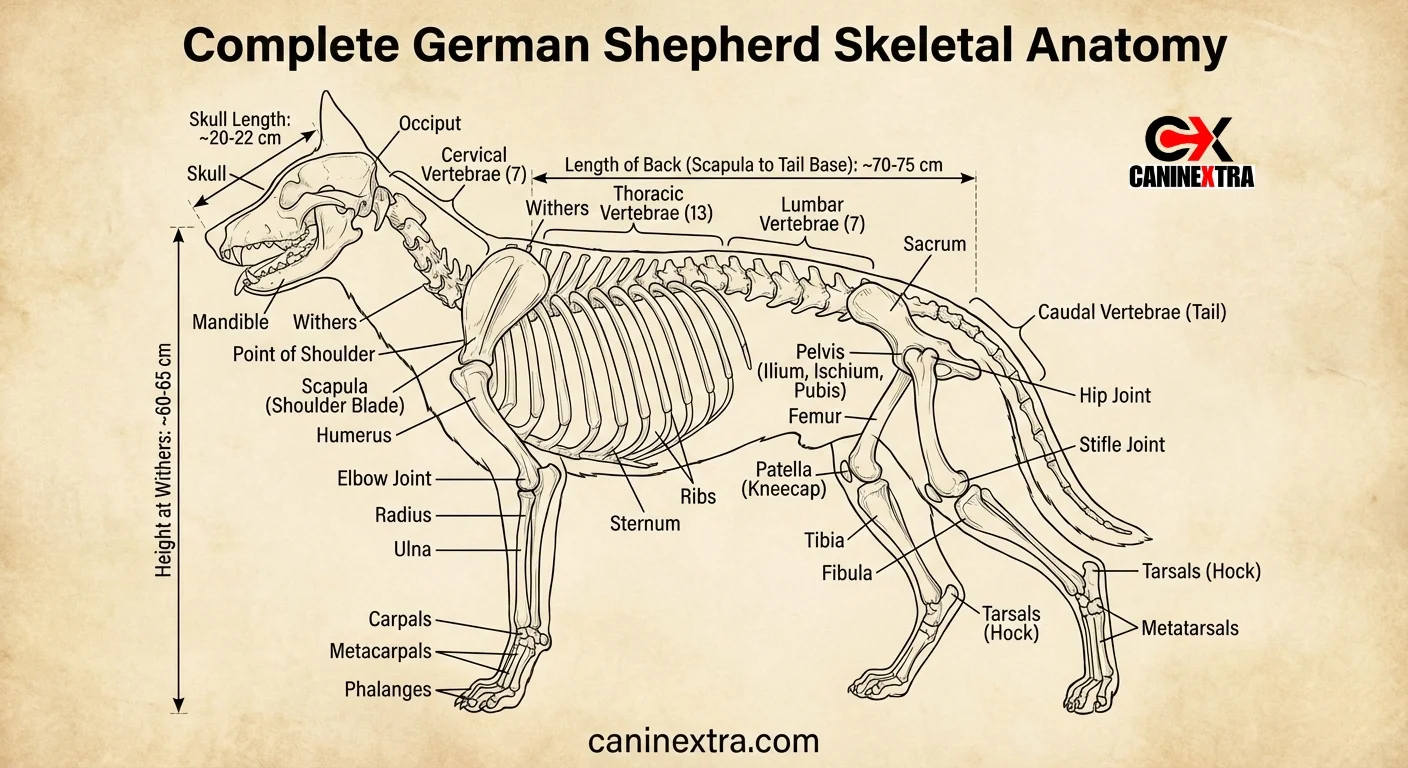
A German Shepherd’s skeleton contains the same basic bones as all dogs but with specific proportions. The height at withers (highest point of the shoulder blades) establishes the dog’s size, while body length (measured from breastbone to rear) should exceed height by approximately 10-17%, creating the slightly elongated profile.
Key skeletal measurements include the upper arm and shoulder blade forming a 90-degree angle, the femur (thigh bone) and tibia/fibula (lower leg bones) creating rear angulation between 110-120 degrees, and the pastern (wrist area) maintaining a 25-degree angle to absorb shock during movement.
German Shepherd Skeletal Structure: Built for Endurance
The German Shepherd’s skeleton is a marvel of functional engineering. Understanding each component helps explain why correct structure matters for health and performance.
Head and Skull: The Wedge-Shaped Foundation
The head is wedge-shaped when seen from above and the side, with the cranial region (skull) making up 50% of the total head length and the muzzle the remaining 50%. This balanced proportion distinguishes the GSD from breeds with shorter or longer muzzles.
The skull should be moderately broad between the ears with a slight furrow running from the forehead down the centerline. When viewed from the front, the head appears wedge-shaped, tapering gradually toward the muzzle without abrupt narrowing. The stop (transition from skull to muzzle) is gentle, not pronounced.
Dentition and Bite
A complete dentition consists of 42 teeth: 20 upper (including 6 incisors, 2 canines, 8 premolars, and 4 molars) and 22 lower (6 incisors, 2 canines, 8 premolars, and 6 molars). The scissors bite, where upper incisors closely overlap lower incisors, is required by the breed standard. Missing first premolars are tolerated in some judging systems but considered undesirable.
The jaw must be strongly developed with powerful muscles to allow the dog to carry objects and maintain grip during protection work. Weak, narrow jaws indicate poor breeding and affect working ability.
Eyes and Ears: Sensory Architecture
Eyes are medium-sized, almond-shaped, and set slightly obliquely. They should be strong and dark in color, light or penetrating eyes suggest nervousness and are considered a fault. The expression conveys confidence, intelligence, and alertness.
Ears are medium-sized, firm in texture, broad at the base, and set high on the skull. They must be carried erect (not tilted) and open toward the front. Hanging ears after 6 months of age disqualify the dog from breeding consideration in most registries. Ear cartilage develops fully between 5-8 months, though some puppies take longer.
Neck and Topline: The Power Transmission System
The neck is strong, well-muscled, and clean (without excess skin). It should be moderately long, roughly equal to the head length, and rise at approximately 45 degrees from the horizontal when the dog stands naturally. This angle allows efficient forward reach during trotting.
The withers (highest point where neck meets back) should be long and pronounced, rising above the back and flowing smoothly into a straight, firm back. The German Shepherd’s topline slopes slightly from the withers toward the croup (rump area), but extreme slopes seen in some modern show lines are incorrect and biomechanically disadvantageous.
A firm, straight back typically measures 60-65% of the height at withers. The loin (lumbar region between ribs and pelvis) should be short and strongly developed, approximately 3-4 vertebrae. Long, weak loins compromise the power transmission from hindquarters to front.
The croup (sacral area forming the rump) should be slightly sloping, approximately 23 degrees from horizontal. Steep or flat croups interfere with proper rear leg drive. The croup flows into the tail set without sharp transitions.
Chest and Rib Cage: The Engine Room
The chest depth should reach approximately 45-48% of the height at withers, with the lowest point of the chest (sternum) level with or slightly below the elbows. This depth allows adequate lung capacity for endurance work.
Ribs should be well-sprung (moderately rounded, not flat or barrel-shaped) and extend well back. The last ribs should be long and well laid-back, creating a smooth transition from chest to loin. The foremost point of the breastbone (prosternum) should extend slightly forward of the shoulder joint when viewed from the side, though excessive protrusion is faulty.
Chest width between the forelegs should allow free movement without being so narrow the legs appear close-set or so wide the dog moves with a rolling gait. Proper width accommodates vital organs while maintaining efficiency.
Front Assembly: Shoulder, Upper Arm, and Foreleg Structure
The front assembly (shoulder, upper arm, and legs) determines 60% of a German Shepherd’s movement quality. Poor front angulation cannot be compensated by excellent rear structure.
Shoulder Blade (Scapula) Placement
The shoulder blade should be long, well laid-back, and slope approximately 45 degrees from vertical when the dog stands naturally. The blade must be flat against the rib cage, not loose or protruding. This placement creates the foundation for efficient forward reach.
A well-placed scapula is roughly equal in length to the upper arm (humerus). The breed standard calls for a 1:1 ratio, though slight variations occur. Short shoulder blades restrict reach and create a choppy, inefficient gait.
Upper Arm (Humerus) Angulation
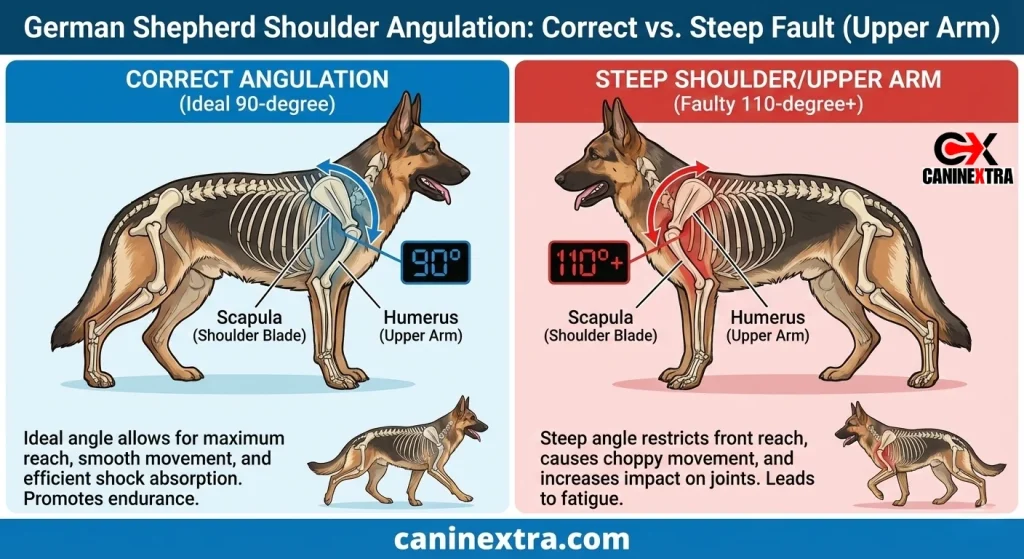
The upper arm connects the shoulder blade to the foreleg at the elbow joint. Optimal angulation places the upper arm at approximately 90 degrees to the shoulder blade, creating a right angle when viewed from the side.
Steep upper arms (angle greater than 100 degrees) are the most common front assembly fault in modern German Shepherds. This steep placement shortens stride length, increases impact stress on joints, and produces the hackney-type gait, high-stepping front action with minimal reach, frequently seen in show rings today.
The upper arm should be long, strongly muscled, and held close to the body. When the dog stands naturally, a vertical line dropped from the back of the shoulder blade should touch the elbow and continue behind the pastern. This alignment indicates correct upper arm placement.
Foreleg Structure and Pastern
The forearm (radius and ulna) extends straight and vertical from the elbow to the pastern. When seen from the front, the forelegs should be parallel, with elbows neither turning out nor pinched against the chest. The legs should appear moderately boned, neither spindly nor overly heavy.
The pastern (carpus and metacarpus, equivalent to human wrist and hand bones) serves as the front assembly’s shock absorber. It should slope approximately 20-25 degrees from vertical and demonstrate firm but slightly springy resilience. Steep pasterns (more vertical) fail to absorb shock properly, leading to joint stress. Weak, over-angulated pasterns indicate ligament laxity and structural weakness.
Feet are rounded and compact with well-arched toes and thick, resilient pads. The nails are strong and dark in color. The front feet turn slightly outward (approximately 5-10 degrees), which is correct for the breed, the so-called “open toward the front” positioning helps maintain balance during the trot.
Rear Assembly: Hip, Thigh, and Hock Mechanics
The hindquarter generates forward propulsion. Correct rear angulation, muscle development, and bone alignment allow the German Shepherd to cover ground efficiently with the characteristic flying trot.
Hip Joint and Upper Thigh (Femur)
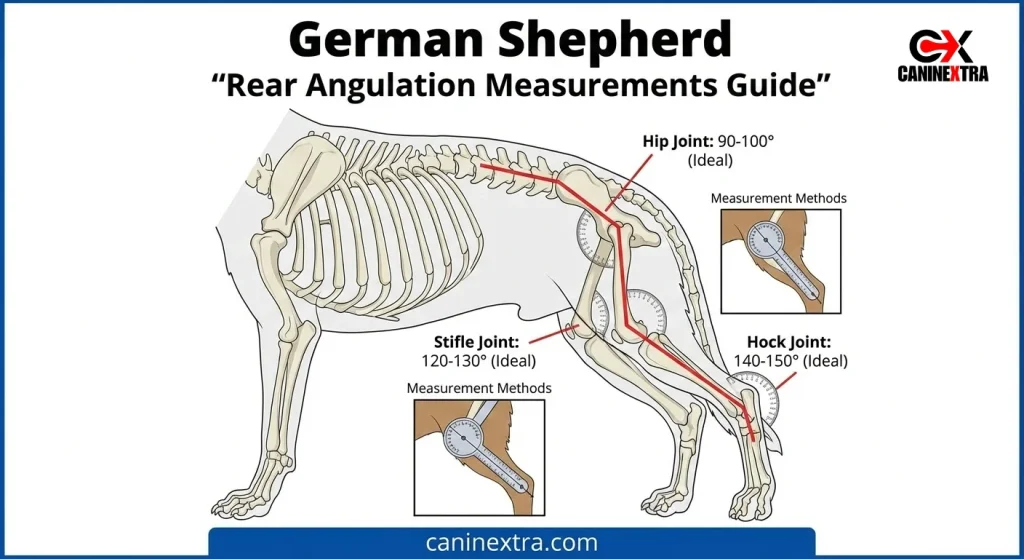
The hip joint connects the femur (thigh bone) to the pelvis at the acetabulum (hip socket). The angle between the pelvis and femur should be approximately 90-100 degrees, allowing the thigh to reach well back under the body during the stance phase of the trot.
The upper thigh should be long, broad, and strongly muscled. When viewed from the side, the thigh extends from the hip joint to the knee joint (stifle) at a slight backward angle. Adequate length and proper angle allow the rear leg to reach forward, providing drive without requiring excessive effort.
Stifle (Knee Joint) and Lower Thigh
The stifle joint connects the femur to the tibia and fibula (bones of the lower thigh and leg). This joint requires substantial angulation, typically 110-120 degrees when measured from front to back of the bones.
Well-angulated stifles extend the rear leg backward during the drive phase and allow the foot to reach far forward during the recovery phase. This range of motion creates efficient ground coverage. Steep or straight stifles restrict movement, forcing the dog to take more frequent, shorter steps.
The lower thigh should be long and well-muscled, extending from the stifle to the hock (ankle joint). The ratio between upper and lower thigh influences stride length, both should be approximately equal, creating balanced angulation.
Hock and Metatarsus (Rear Pastern)
The hock joint serves as the rear assembly’s primary leverage point. When the dog stands naturally, the hock should be perpendicular to the ground or just slightly angled forward. The metatarsus (rear pastern, equivalent to human ankle to toes) extends from the hock to the rear foot.
Strong, clean hocks indicate good tendon and ligament development. Thick, puffy hocks suggest weakness. When viewed from behind, hocks should be parallel, neither turning in (cow-hocked) nor turning out. The distance between the hocks should roughly match the distance between the hip joints.
Rear feet are compact and slightly longer than front feet, with well-arched toes and thick pads. Dewclaws on rear legs should be removed shortly after birth, as they serve no function and risk injury.
Understanding German Shepherd Angulation
Angulation refers to the angles formed where bones meet at joints. Proper angulation allows efficient movement, while excessive or insufficient angulation creates biomechanical problems.
Front Angulation Requirements
Correct front angulation requires the shoulder blade and upper arm to form approximately a 90-degree angle. This creates maximum reach, the distance the front leg extends forward during each stride. When front angulation is correct, the dog’s front foot lands well ahead of the nose, allowing the body to float smoothly over the front legs.
The relationship between shoulder layback (scapula angle) and upper arm angle determines reach. Even if the shoulder blade lies at the ideal 45 degrees, a steep upper arm (positioned too vertically) shortens reach and restricts smooth movement. Both elements must be correct.
Rear Angulation Balance
Rear angulation involves three primary joints: hip-to-femur, femur-to-tibia (stifle), and tibia-to-hock. Combined rear angulation typically measures 110-120 degrees at the stifle when the dog stands naturally.
Moderate rear angulation allows the rear leg to reach far forward under the body during the recovery phase and extend well behind during the drive phase. This creates the powerful thrust that propels the dog forward.
The Angulation Controversy
Modern show-line German Shepherds have developed increasingly extreme rear angulation—stifles approaching 90 degrees or less. Breeders pursuing this look believe it creates more ground-covering movement and a more elegant profile.
However, excessive rear angulation creates serious problems. The dog must constantly compensate for the imbalance, often standing with hocks angled forward and feet positioned too far behind. This places abnormal stress on joints and ligaments, increasing injury risk and potentially contributing to early hip dysplasia.
Working-line German Shepherds maintain moderate angulation closer to the original breed standard. These dogs demonstrate superior athletic ability, joint health, and longevity compared to extreme show lines. Buyers seeking healthy, functional dogs should prioritize moderate angulation.
German Shepherd Gait: The Flying Trot Explained
The German Shepherd’s gait, specifically the trot, defines the breed more than any other characteristic. Understanding correct gaiting helps evaluate structural quality.
What Is the Trot?
The trot is a two-beat diagonal gait where the dog moves the right front and left rear legs forward simultaneously, then the left front and right rear. This efficient gait allows sustained speed and endurance with minimal energy expenditure.
At a proper trot, the German Shepherd appears to float effortlessly across the ground. The back remains level (slight slope acceptable), and the legs move with minimal wasted motion. The front legs reach forward while the rear legs drive powerfully from behind.
The Flying Trot: Maximum Extension
The “flying trot” describes the moment when all four feet are off the ground simultaneously. The front leg extends forward to maximum reach while the rear leg extends backward at maximum drive. Observers often describe this as the dog appearing to fly.
Achieving the flying trot requires correct angulation front and rear, proper proportions, strong topline, and excellent conditioning. Dogs with structural faults cannot achieve this level of extension and instead compensate with shorter, choppier strides or pacing (moving both legs on the same side together).
Evaluating Movement Quality
Quality movement demonstrates these characteristics:
Reach: The front leg extends forward so the foot lands well ahead of the nose. The leg moves straight forward without paddling (swinging out) or winging (throwing inward).
Drive: The rear leg extends behind the body so the hock straightens almost completely. Strong drive propels the dog forward efficiently without hopping or pushing upward.
Topline Stability: The back remains firm and level (or with slight acceptable slope) during movement. The topline shouldn’t bounce, sag, or show excessive curvature.
Tracking: At a normal trot, the feet should land in a straight line. At a fast trot, the legs converge slightly toward the center line beneath the body (single-tracking), which is correct and efficient.
Fluidity: Movement appears smooth and effortless. The dog covers maximum ground with minimal visible effort.
Common Gait Faults
Several structural problems manifest as gait faults:
Pacing: Moving both legs on one side together indicates structural imbalance, often from mismatched front and rear angulation.
Hackneying: High-stepping front action with minimal reach results from steep shoulders and upper arms.
Crabbing: Moving with the body angled rather than straight ahead compensates for rear structure problems.
Cow-hocking: Hocks turning inward during movement indicates rear assembly weakness.
Close movement: Legs positioned too close together or crossing suggests narrow body structure.
Learn more about gait mechanics in our comprehensive guide to German Shepherd movement and gaiting
Body Proportions and Measurements
Correct proportions create the German Shepherd’s functional, athletic silhouette. These measurements aren’t arbitrary, each relates directly to working ability.
Height at the Withers
The withers (highest point of the shoulder blades between the neck and back) serves as the reference point for all other measurements. Males should measure 60-65 cm (23.6-25.6 inches) at the withers, while females measure 55-60 cm (21.7-23.6 inches).
Height variations outside this range are considered faults. Dogs significantly over or under standard height often experience proportion problems that affect movement and longevity.
Body Length vs. Height
The German Shepherd is slightly longer than tall, with body length (measured from the foremost point of the breastbone to the rear of the pelvis) exceeding height at withers by 10-17%. This creates the slightly elongated profile characteristic of the breed.
The ratio should be approximately 1.1:1 to 1.17:1 (body length to height). Dogs too long appear stretched and weak, while square dogs (equal height and length) lack the reach and drive required for efficient trotting.
Weight Ranges and Body Condition
While the breed standard focuses on proportions rather than weight, typical weights for properly conditioned dogs are:
- Males: 30-40 kg (66-88 pounds)
- Females: 22-32 kg (48-70 pounds)
Individual dogs may fall outside these ranges depending on bone structure and muscle mass. The key is maintaining lean, athletic condition. You should be able to feel ribs easily without seeing them prominently, excess weight stresses joints and shortens lifespan, particularly given the breed’s susceptibility to hip dysplasia.
Critical Proportion Relationships
Several proportion relationships determine structural quality:
Shoulder blade length to upper arm length: Ideally 1:1, though variations occur. Both should be long for maximum reach.
Chest depth to height ratio: Chest depth should measure 45-48% of height at withers.
Upper thigh to lower thigh ratio: Approximately 1:1, creating balanced rear angulation.
Back length to loin length: The back should be roughly twice as long as the loin, with the loin measuring only 3-4 vertebrae.
Breed Standard Specifications: What Makes a Correct GSD
The breed standard defines the ideal German Shepherd Dog. Understanding these specifications helps evaluate breeding stock and show dogs.
General Appearance Requirements
The breed standard describes the German Shepherd as a medium-size dog, slightly elongated, with strong, well-muscled body and dry, close-fitting skin. The dog should be approachable, confident, and easy to train, temperament is as important as physical structure.
Head Specifications in Detail
The head must be wedge-shaped and proportional to body size, measuring approximately 40% of the height at withers. The forehead should be slightly arched, not flat or domed. The muzzle is strong, neither pointed nor excessively broad.
Nose leather should be black, any other color disqualifies the dog. Lips must be firm and close-fitting, also black. Pink or liver-colored lips indicate pigment faults.
Coat and Color Standards
The German Shepherd sports a double coat consisting of a straight, harsh outer coat lying flat against the body and a thick undercoat. Coat length should be medium, neither too short (like a Rottweiler) nor too long (like a Collie).
Acceptable colors include black with tan, red, brown, or gray markings; solid black; solid gray; or gray with brown/tan markings (sable). The classic “saddle” pattern features a black back with tan legs and underside. White markings on the chest or very light colors are undesirable but don’t disqualify unless excessive.
Disqualifying Faults
Certain faults automatically disqualify dogs from breeding consideration:
- Hanging ears after 6 months of age
- Serious bite faults (overshot/undershot jaws exceeding 2mm)
- Weak temperament (excessive shyness or aggression)
- Monorchidism or cryptorchidism (missing or undescended testicles)
- Docked tail
- Serious structural deformities
Less severe faults (considered undesirable but not disqualifying) include missing first premolars, light eyes, faulty coat texture, minor proportion imbalances, and slight movement deficiencies.
Health Implications of Structural Faults
Anatomical structure directly impacts long-term health. Understanding this connection helps buyers make informed decisions.
Hip Dysplasia and Rear Structure
Hip dysplasia, a developmental condition where the hip joint forms improperly, affects German Shepherds more than most breeds. While partially genetic, structural factors influence severity.
Excessive rear angulation places abnormal stress on hip joints. Dogs with extreme angulation often show dysplasia symptoms earlier and more severely than moderately angulated dogs. The constant compensation required to maintain balance accelerates joint deterioration.
Working-line dogs with moderate angulation show significantly lower hip dysplasia rates than show-line dogs. Responsible breeders screen breeding stock using radiographic evaluation (OFA or PennHIP scoring) and select for improved hip structure.
Discover more about hip dysplasia prevention and treatment
Elbow Dysplasia and Front Assembly
Elbow dysplasia includes several developmental conditions affecting the elbow joint. Steep upper arms and poor shoulder angulation increase elbow stress, potentially contributing to dysplasia development.
Dogs with correct front angulation distribute weight efficiently across the joint surfaces. Structural faults concentrate stress in specific areas, accelerating wear and inflammation.
Spinal Issues and Topline Structure
The German Shepherd’s slightly sloping topline is correct when moderate. However, extreme slopes seen in modern show lines create spinal stress.
Exaggerated slopes often accompany shortened backs and steep croups, forcing the spine into unnatural curvature. This increases the risk of conditions like degenerative myelopathy, cauda equina syndrome, and intervertebral disc disease.
Long-Term Mobility Implications
Dogs with significant structural faults typically show mobility problems earlier in life. Common issues include premature arthritis, ligament injuries (especially cruciate ligament tears), and chronic pain.
Buyers prioritizing long-term health should select dogs from working lines or moderate show lines with proven orthopedic health in pedigrees. Avoid breeders pursuing extreme angulation or exaggerated features.
Differences Between Show Lines and Working Lines
German Shepherd breeding has diverged into distinct types with different structural priorities.
Show Line Characteristics
Show-line dogs, particularly American and some German show lines, exhibit more pronounced features: longer, more flowing coats; more angulated rears; steeper, more sloping backs; and larger, heavier-boned structure.
These dogs excel in conformation showing but often lack the drive and working ability of working lines. Health problems are more common, and average lifespan may be shorter due to structural issues.
Working Line Structure
Working-line German Shepherds maintain structure closer to the breed’s original intent. They feature moderate angulation front and rear, straighter toplines, more athletic builds, and higher drive for work.
These dogs dominate in schutzhund, police work, search and rescue, and other demanding activities. They typically enjoy better orthopedic health and longer lifespans than extreme show lines.
Czech and DDR Lines
Eastern European lines (particularly Czech and former East German/DDR lines) represent the most functional German Shepherd structure. Bred exclusively for working ability during the Cold War, these lines showcase moderate angulation, straight backs, and exceptional health.
Dogs from these lines often show the lowest hip dysplasia rates and maintain working ability into old age. They’re increasingly popular among buyers seeking healthy, athletic German Shepherds.
Evaluating Puppies: Structure Assessment at Different Ages
Assessing puppy structure requires understanding developmental stages.
8-Week Evaluation
At 8 weeks, puppies appear disproportionate, huge feet, big heads, short legs. Experienced breeders can identify structural quality even at this age by examining:
Proportions: Puppy should already show slightly longer-than-tall proportions, though less pronounced than adults.
Angulation: Front and rear angles should be evident, though not fully developed.
Bone: Leg bones should appear straight with appropriate thickness, neither spindly nor overly heavy.
Head: Already shows wedge-shaped profile with proper eye placement and expression.
Movement: Puppies should move fluidly without obvious gait faults. The rear shouldn’t appear weak or unstable.
6-Month Structure Check
At 6 months, structure becomes more apparent. The puppy enters an awkward phase where body parts grow at different rates. Expect temporary proportion imbalances, but underlying structural quality should be visible.
Key indicators include developing angulation, topline taking shape (slight slope emerging), and chest beginning to deepen. Ears should be fully erect by this age, hanging ears suggest weakness.
Young Adult Assessment (12-18 Months)
By 12-18 months, males are approaching adult structure while females may be nearly finished growing. This is the ideal time for preliminary hip and elbow radiographs to assess joint development.
Movement quality becomes evident. The young dog should demonstrate developing reach and drive, though full power develops with maturity and conditioning.
Maturity (24+ Months)
German Shepherds reach full physical maturity between 24-36 months. Males continue filling out through age 3, developing full chest depth and muscle mass. This is when final structural assessment occurs.
Mature dogs should display all breed characteristics: correct proportions, proper angulation, efficient movement, and confident temperament. Any structural faults present at maturity are permanent.
Learn about proper puppy development milestones
Frequently Asked Questions
What is the ideal height for a German Shepherd?
Males should measure 60-65 cm (23.6-25.6 inches) at the withers, while females measure 55-60 cm (21.7-23.6 inches). The withers are the highest point of the shoulder blades. Dogs significantly outside this range often experience proportion problems affecting movement and health.
How do you measure angulation in German Shepherds?
Angulation is measured using the angles formed where bones meet at joints. For the shoulder, measure the angle between the shoulder blade and upper arm (should be approximately 90 degrees). For the rear, measure at the stifle (knee) joint between the upper and lower thigh bones (typically 110-120 degrees). Professional breeders often use specialized angle measuring tools or analyze photographs.
What causes cow hocks in German Shepherds?
Cow hocks (hocks turning inward when viewed from behind) result from rear assembly structural faults, weak ligaments, or genetic factors. Contributing factors include excessive rear angulation, narrow pelvic structure, and poor conditioning. While mild cow hocking may not significantly impact working ability, moderate to severe cases indicate structural weakness.
Read our detailed guide on cow hock causes and correction
Is extreme angulation bad for German Shepherds?
Yes. Excessive rear angulation, while favored in some show rings, creates serious health problems including increased hip dysplasia risk, chronic joint stress, premature arthritis, and reduced working ability. Dogs with moderate angulation demonstrate superior health, longevity, and athletic performance. Responsible breeders prioritize function over exaggerated appearance.
What is the correct topline for a German Shepherd?
The correct topline flows smoothly from the prominent withers along a firm, straight back with a slight slope toward the croup. The slope should be moderate, approximately 10-15 degrees from horizontal. Extreme slopes seen in modern show lines are incorrect and biomechanically disadvantageous, increasing spinal stress and movement problems.
How long should a German Shepherd’s legs be compared to body height?
Leg length should allow the chest to reach approximately 45-48% of the height at withers. This means if a male stands 63 cm at the withers, his chest should measure roughly 28-30 cm deep. Proper leg length creates correct proportions, neither too short (appearing stubby) nor too long (appearing leggy and weak).
What does “slightly longer than tall” mean for German Shepherds?
This describes the breed’s rectangular outline where body length (measured from the foremost point of the breastbone to the rear of the pelvis) exceeds height at withers by 10-17%. For example, a dog measuring 60 cm at the withers should be approximately 66-70 cm long. This slight elongation optimizes trotting efficiency.
Why are German Shepherd ears important to structure?
Erect ears are a breed requirement indicating proper cartilage development and genetic health. Hanging ears after 6 months disqualify dogs from breeding. While primarily cosmetic, ear carriage reflects overall structural quality, dogs with excellent body structure typically have correct ears, while structural weaknesses often correlate with ear problems.
Can you fix structural faults in German Shepherds?
No. Skeletal structure is determined by genetics and early development. Once bones finish growing (18-24 months), structure cannot be changed. This is why selecting structurally correct puppies from health-tested parents is crucial. Exercise and conditioning improve muscle tone and movement quality but cannot alter bone angles or proportions.
What’s the difference between working line and show line anatomy?
Working lines feature moderate angulation, straighter toplines, athletic builds, and functional proportions optimized for sustained work. Show lines display more pronounced features: increased rear angulation, steeper toplines, heavier bone, and more coat. Working lines typically demonstrate superior health, while extreme show lines experience more orthopedic problems.
How does German Shepherd structure affect hip dysplasia risk?
Excessive rear angulation, steep croups, and proportion imbalances increase mechanical stress on hip joints, potentially accelerating dysplasia development in genetically susceptible dogs. Moderate structure with balanced angulation distributes forces efficiently, reducing stress. However, hip dysplasia is primarily genetic, structure influences severity in affected dogs but doesn’t cause the condition in genetically clear dogs.
What is the correct German Shepherd bite?
A scissors bite, where upper incisors closely overlap lower incisors when the mouth closes, is correct. The dog should have complete dentition: 42 teeth (20 upper, 22 lower). Missing first premolars are tolerated by some registries. Overshot or undershot bites exceeding 2mm gap disqualify dogs from breeding.
Conclusion
German Shepherd anatomy represents over a century of selective breeding for working excellence. Every angle, proportion, and structural element serves the breed’s original purpose: efficient, tireless trotting while herding flocks and performing protection work.
Understanding correct structure helps you evaluate breeding stock, select healthy puppies, and appreciate what makes exceptional German Shepherds extraordinary. While modern show breeding has introduced concerning trends toward structural extremes, working-line breeders maintain the functional anatomy that defines this remarkable breed.
Prioritize moderate angulation, correct proportions, and proven orthopedic health when selecting your German Shepherd. Dogs built according to the original breed standard enjoy longer, healthier, more active lives than those bred for exaggerated appearance.
Whether you’re breeding German Shepherds, competing in conformation or working trials, or simply want a healthy family companion, let function guide your choices. The German Shepherd’s anatomy evolved to create an athletic, capable working dog, preserving that functional structure honors the breed’s heritage and ensures its future.
Next Steps: If you’re evaluating German Shepherds for breeding or purchase, examine dogs in motion, not just standing. Request hip and elbow clearances from certified organizations (OFA, PennHIP, or equivalent). Study pedigrees for proven health and working ability. Most importantly, seek breeders who prioritize function and health over appearance extremes.
Master the art of proper German Shepherd stacking for shows and evaluation
