

Your German Shepherd Dog’s structure tells a story, but only if you know how to present it correctly. Stacking isn’t just about placing legs for a photo. It’s about showcasing proper angulation, balance, and the physical traits that define a sound, functional working dog.
Whether you’re preparing for your first conformation show, evaluating breeding prospects, or simply want to understand your GSD’s structure better, mastering the stack is important. A correctly stacked dog reveals everything judges and breeders need to see: shoulder angles, topline strength, rear drive capability, and overall balance.
Key Takeaways:
- German Shepherds use a unique three-point stack (versus the four-point stack used by most breeds) to showcase their trotting mechanics
- Proper stacking reveals structural soundness and helps predict working ability without the need for extensive movement tests
- The left rear leg extends perpendicular to the ground while the right rear stays under the body, this specific positioning highlights natural angulation
- Common mistakes like overstretching the rear or dropping the head can distort a dog’s true conformation by 20-30%
- Training a puppy to stack takes 4-8 weeks of daily 5-minute sessions with patience and positive reinforcement
What Is a German Shepherd Dog Stack?
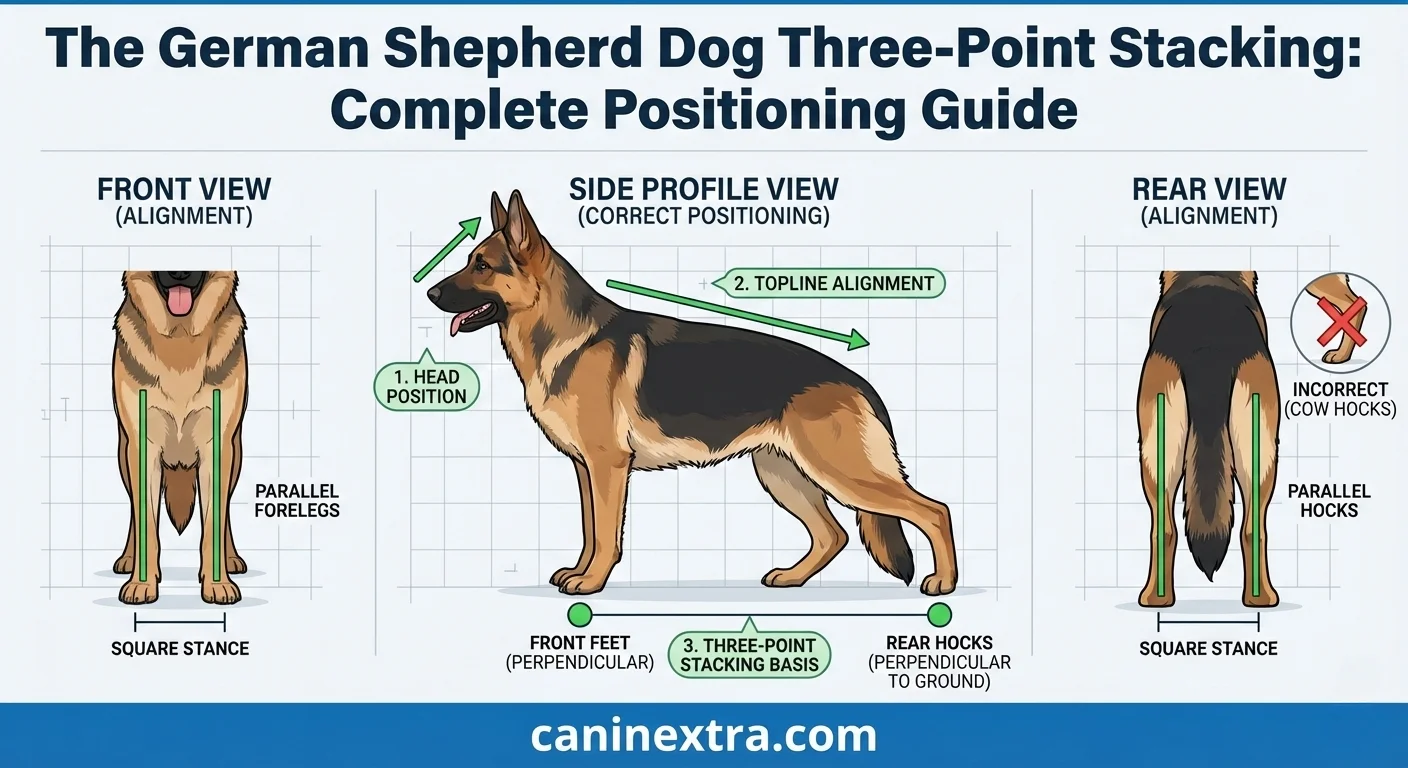
A German Shepherd dog stacking is the specific three-point stance that positions the dog to display its natural conformation according to breed standards. Unlike most breeds that stand square with all four legs aligned vertically, GSDs are stacked with their rear legs in an asymmetric position: one leg extended back and one tucked under the body.
This unique positioning serves a functional purpose. German Shepherds were bred as trotting herding dogs, and the breed requires proper angulation to cover more ground with fewer steps, contributing to the endurance necessary for extended trotting periods. The three-point stack mirrors the dog’s natural stance before launching into motion, revealing the skeletal angles and muscular development needed for efficient movement.
When properly stacked, a GSD displays:
- Front legs: Perpendicular to the ground, positioned directly under the shoulders with feet pointing straight forward
- Left rear leg: Extended back with the lower leg (from hock to foot) perpendicular to the ground
- Right rear leg: Positioned under the body below the stomach area
- Topline: Level back from withers to croup, showing proper spine alignment
- Head position: Raised and alert with ears forward, demonstrating breed temperament
- Weight distribution: Balanced across all four legs without favoring any limb
The stack provides judges and breeders with immediate insight into a dog’s structural correctness. It reveals shoulder layback, rear angulation, body proportions, and whether the dog possesses the physical capabilities to perform its original herding function efficiently.
Why German Shepherds Stack Differently
The three-point stack isn’t arbitrary, it’s rooted in the breed’s working heritage. German Shepherds are trotting dogs that function as tending breeds, traditionally used as a living, moving fence to prevent sheep herds from straying. This work required hours of sustained trotting at moderate speed.
The extended rear leg position in the stack demonstrates the dog’s rear angulation, the angles formed by the femur, tibia, and metatarsal bones. Proper angulation allows the hind legs to reach far under the body during the trot, generating the forward thrust needed for efficient, ground-covering movement. Dogs with insufficient angulation tire quickly and cannot maintain the extended trot that defines correct GSD movement.
Why Correct Stacking Matters for German Shepherds
Proper stacking isn’t just cosmetic, it serves critical purposes for breeders, handlers, and owners who care about structural soundness.
Evaluating Breeding Quality
Breeders rely on stacking to assess whether a dog should be included in their breeding program. The stack reveals structural faults that might not be apparent when a dog is moving or standing casually. Issues like cow hocks (hocks that turn inward), east-west feet (front feet that turn outward), straight shoulders, or weak pasterns become immediately visible in a proper stack.
A dog with excellent movement might still have structural weaknesses that will pass to offspring. Conformation is important to GSDs because as a working breed they need to be built correctly for the type of work they do in order to be healthy and work for many years without breaking down. Stacking provides a systematic way to evaluate these structural components before making breeding decisions.
Conformation Show Requirements
In the show ring, stacking is mandatory. Judges have limited time to assess each dog, typically 2-3 minutes per individual. The stack gives judges their primary opportunity to evaluate the dog against breed standards. Stacking can provide good insight regarding a dog’s structure, is essential for showing a dog in the conformation ring, and is a respected tradition within the breed community.
Show-quality GSDs must hold a stack for 3-5 minutes while maintaining alertness and proper position. Dogs that fidget, shift weight, or break position lose critical points. Professional handlers spend months training dogs to stack naturally on command and hold the position reliably.
Photography and Marketing
For breeders advertising stud services or puppies, professional stack photos are essential marketing tools. People often fail to realize that when it comes to website photos and general advertisement of their dogs, presentation is very important. A well-stacked photo allows potential buyers to accurately assess a dog’s structure without seeing the dog in person.
Poor stacking can make an excellent dog look mediocre, while manipulated stacking can temporarily hide faults. This is why learning proper technique matters, honest presentation builds trust and reputation within the breeding community.
Understanding Your Dog’s Health Potential
Even companion dog owners benefit from understanding stacking. While you may never enter a show ring, evaluating your GSD’s natural stack reveals whether they have the structural soundness for an active lifestyle. Bad conformation is more than just cosmetic, it could potentially cause health issues, especially joint issues.
Dogs with correct conformation typically experience fewer orthopedic problems as they age. They can run, play, and work comfortably without excessive strain on joints and ligaments. Recognizing structural issues early allows you to adjust exercise routines, provide targeted conditioning, and make informed decisions about activities like agility or protection work.
Step-by-Step Guide: How to Stack a German Shepherd
Stacking requires patience, practice, and proper technique. Here’s the professional method used by experienced handlers.
Before You Begin: Preparation
Choose a flat, level surface. Grass works well for outdoor photos but should be cut short enough to see the dog’s feet clearly. Avoid sloped surfaces that force the dog to adjust their natural stance.
Tire your dog slightly before stacking sessions. A brief 5-minute walk gets them focused and settles excess energy. You want alert but calm, not exhausted or hyperactive.
Have treats or bait ready. Use whatever motivates your dog: favorite toy, cheese, hot dogs, or commercial show bait. You’ll need this to maintain head position and attention.
Step 1: Position the Front Legs
The front assembly is your foundation. Set it first, then build the rest of the stack around it.
Hold the dog underneath the jaw or by the collar while you set the front legs. Avoid lifting the dog by the front legs and dropping them, this technique looks clumsy and often results in misaligned feet.
Place the left front leg first. Position it directly under the shoulder with the foot pointing straight forward. The leg should be perpendicular to the ground when viewed from the side.
Next, place the right front leg parallel to the left, spaced 5-6 inches apart. Both feet should point straight ahead with toes aligned. The distance between front feet should roughly equal the width of the dog’s chest.
Check alignment from the front. The legs should create two straight vertical lines from shoulder to ground. If feet turn outward (east-west) or inward (toeing in), adjust by rotating the leg at the elbow, never force the feet into position as this creates discomfort.
Step 2: Set the Rear Legs
The rear assembly requires more finesse since you’re creating an asymmetric position.
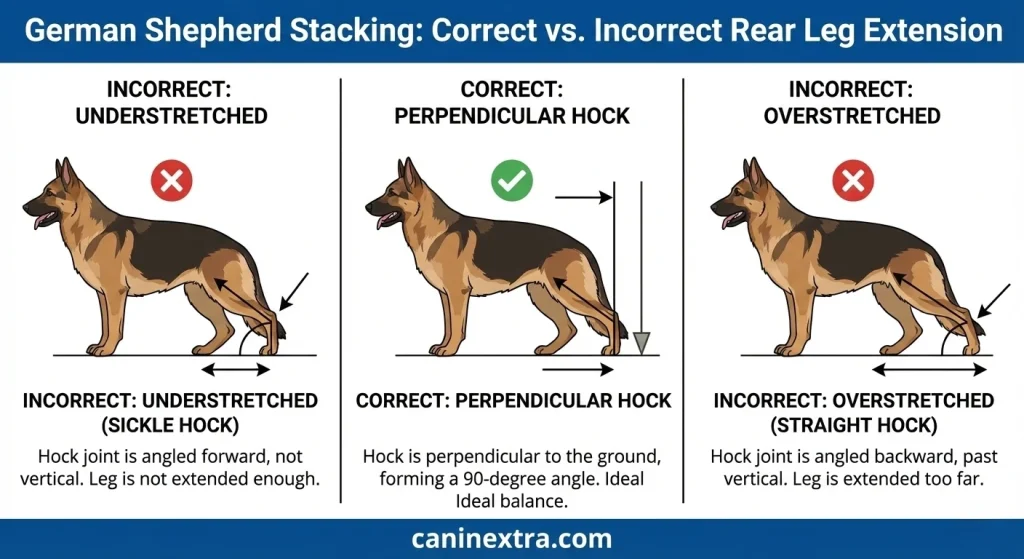
Start with the left rear leg (the one that extends back). Grab the left hock by the top and stretch back to place the lower leg perpendicular to the ground. The hock (ankle joint) should form a right angle when properly positioned.
How far back should you extend? This depends on your dog’s natural angulation. Pull until the lower leg (from hock to foot) stands vertical. If you overstretch, the rear angles distort and the dog looks unbalanced. If you don’t extend enough, you won’t showcase the dog’s true angulation.
For the right rear leg, position it under the body. Use your foot as a marker, place it where you want the dog’s rear foot to land, typically below the hip. Lift the hock gently and guide the leg forward into position. Many dogs will drop this leg correctly if you simply lift and release while pulling slightly forward.
The right rear foot should rest flat on the ground directly under the body, creating a stable triangle of support with the two front legs.
Step 3: Adjust the Head and Topline
Head position dramatically affects how the entire dog appears. A dropped head makes strong withers look flat and creates a droopy, disinterested appearance.
The head of the dog should be facing forward. If you do not have someone to help get ears up and the head forward, just throw a piece of bait or another object. Position your hand under the dog’s jaw where neck meets head, this gives you control without blocking the forechest.
Raise the head to a natural alert position. The neck should extend upward with a slight arch. Ears should be forward and erect. Use bait held slightly above eye level to achieve and maintain this position.
Check the topline. The back should run relatively level from withers to croup, GSDs have a slight natural slope but it shouldn’t appear exaggerated. If the topline dips or rises dramatically, your leg positioning needs adjustment.
Step 4: Fine-Tuning and Maintaining Position
Step back slightly while maintaining control of the head. Observe the overall picture:
- Weight evenly distributed across all four legs
- Front legs vertical from all angles
- Left rear extended with lower leg perpendicular
- Right rear under body providing support
- Level topline without dips or humps
- Alert head position with ears forward
- Tail hanging naturally (avoid holding or manipulating the tail)
Make minor adjustments by shifting individual legs. Avoid major repositioning, if the stack looks significantly off, start over rather than trying to fix multiple problems simultaneously.
Hold the position for 15-30 seconds initially. As your dog gains experience, gradually extend the duration to 3-5 minutes for show ring readiness.
Common Hand Positions
Professional handlers minimize their visibility in stack photos and show rings. Your hands should be on the dog’s collar, or holding the dog’s jaw (on the right side), so you are as unobtrusive as possible. If the dog will hold the stack, back out of the picture entirely.
Never place your hands on the dog’s chest or stick your feet behind the hock to keep the dog in place. These techniques hide the forechest and look unprofessional.
Training Your GSD to Stack Like a Champion
Young dogs don’t naturally hold a stack. Training requires time, consistency, and positive reinforcement.
Start Early: Puppy Foundation Training
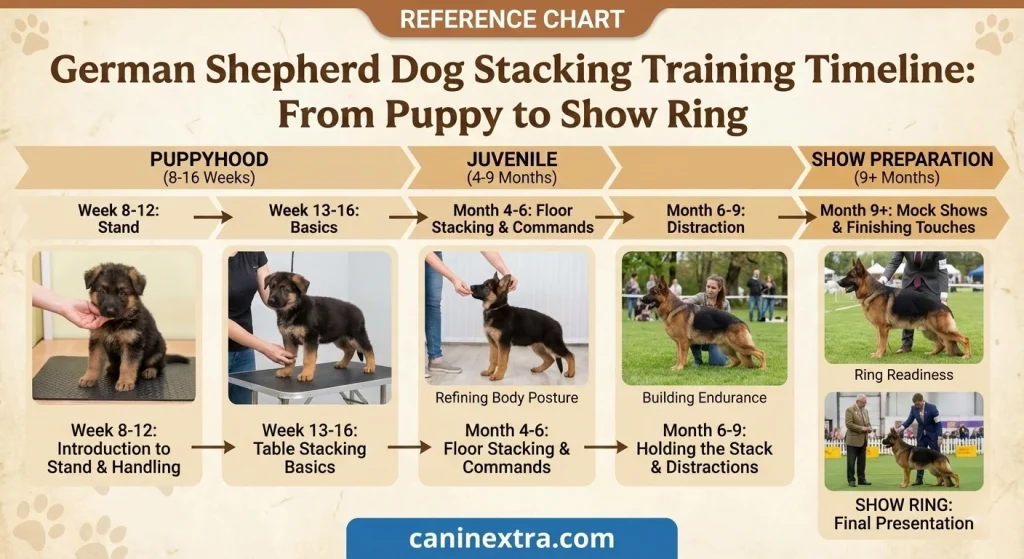
Begin stack training at 8-12 weeks old. Puppies this age are highly trainable and haven’t developed resistant habits. Training should begin with your show line German Shepherd dog as soon as you bring them home. This growing period is the most impressionable for the puppy.
Keep early sessions brief, just 2-3 minutes once or twice daily. Young puppies have short attention spans. End sessions before the puppy gets frustrated or bored.
Start with basic positioning without worrying about perfection. Simply place the puppy’s legs in approximately correct positions, say your stack command (“Stack” or “Stand”), and immediately reward. The goal is building positive associations, not perfect form.
Progressive Training Method
Weeks 1-2: Basic Positioning
Focus on standing still. Place the puppy in a rough approximation of a stack. Reward immediately for staying in position for just 2-3 seconds. Don’t worry about perfect leg placement yet, you’re teaching the concept of holding still on command.
Use a consistent verbal cue each time: “Stack,” “Stand,” or “Steh” (German command). Say the cue as you position the dog, then reward within 1-2 seconds.
Weeks 3-4: Duration Building
Gradually extend hold time. Start requiring 5 seconds, then 10, then 15. Reward after the dog successfully holds the position for the target duration.
If your dog breaks position early, calmly reposition and try again with a shorter duration. Never punish breaking, this creates negative associations with stacking.
Weeks 5-6: Precision Work
Now refine leg placement. Take time to position each leg correctly. Your dog should be comfortable holding still, so you can focus on technical accuracy.
Reward precision. Give bigger treats or extra praise when your dog maintains excellent form with all legs properly aligned.
Weeks 7-8: Distance and Distraction
Practice stepping away while your dog holds the stack. Start with just one step back, gradually increasing to 6-8 feet away.
Introduce mild distractions: other people walking nearby, toys on the ground, or other dogs in the area. Your GSD needs to hold position despite environmental stimuli in show rings.
Use of Markers and Clickers
One method that can be used starting with the young puppy is to mark the correct stance with either a clicker or marker word. With the use of treats or a favorite toy to use as a lure, move the puppy forward while you slowly move backwards. When the puppy naturally poses itself correctly, click and reward.
This capturing method lets the dog learn through natural behavior rather than forced positioning. Many dogs naturally stack before launching into movement—capturing these moments with a marker teaches them to intentionally recreate the position.
Training Challenges and Solutions
Problem: Dog keeps shifting rear legs
Solution: Your dog may be uncomfortable or the position is too extreme for their current structure. Check that you’re not overextending the rear. Some dogs need a more moderate extension, especially young dogs still developing angulation.
Problem: Head drops immediately when you release
Solution: Build duration with bait at eye level. Only reward when the head remains up. Practice with a helper holding bait while you position the dog.
Problem: Dog anticipates the stack and moves before you’re ready
Solution: Vary your pattern of movement and cues so the dog doesn’t predict the stack. Mix up your approach, sometimes position front legs first, sometimes rear. Change locations and timing.
Problem: Front feet turn outward (east-west)
Solution: This is often structural rather than training-related. If the feet naturally turn out, you’ll need to manually position them straight for photos and shows. Work with a breeder or handler to assess whether this is correctable through conditioning exercises.
Making Training Enjoyable
Most essential to beginning ring training with a puppy is to make sure the puppy is enjoying themselves, and it is fun. Stack training should never feel like punishment.
Use high-value rewards. Regular kibble isn’t motivating enough. Use special treats reserved exclusively for stack training: cheese, hot dogs, freeze-dried liver, or whatever your GSD finds irresistible.
Keep sessions short, end on a positive note after 5-10 minutes. Don’t overdo it. Multiple short sessions throughout the day build skills faster than one long, tedious session.
Celebrate success. When your dog nails a beautiful stack, make a big deal about it. Excited praise, treats, and a brief play session reinforce that stacking leads to wonderful things.
For more training insights, explore our guide on ring training fundamentals for working breeds.
Common Stacking Mistakes and How to Avoid Them
Even experienced handlers make errors that distort a dog’s true conformation.
Overstretching the Rear
The most frequent mistake is pulling the left rear leg back too far. Avoid overstretching the dog, as this will distort the rear angles and make the dog look unbalanced and weak.
How to avoid: The lower leg (hock to foot) should be perpendicular to the ground, that’s your measuring point. If the angle exceeds 90 degrees, you’ve gone too far.
Front Legs Too Wide or Too Narrow
Front leg spacing affects the entire appearance. Too wide makes the dog look coarse and lacking elegance. Too narrow creates an unbalanced look and suggests weak front assembly.
How to avoid: Space front feet 5-6 inches apart for most adult GSDs, adjusted proportionally for smaller or larger dogs. The space should roughly equal chest width.
Dropped Head Position
A low head carriage ruins the entire stack. If you allow the dog to drop its head, a dog with a high wither ends up with an “ok” wither or a flat wither. A dog with a flat wither ends up with a dip in the wither.
How to avoid: Maintain bait at eye level or slightly above. Keep one hand under the jaw to provide gentle support. Never allow the dog to sniff the ground or look down during stacking.
Manipulating the Topline
Some handlers artificially manipulate the back by pushing down on the croup or lifting the withers. This creates a false picture of the dog’s structure.
How to avoid: Let the topline fall naturally. If the back appears weak or roached when properly stacked, that’s the dog’s true structure, manipulating it to look better in photos is dishonest and wastes judges’ time when the dog moves.
Hiding Structural Faults
A dog’s body can be easily manipulated to cover things up or exaggerate angles. This is why correct positioning is of vital importance.
Ethical breeders and handlers present dogs honestly. If your GSD has east-west feet, straight shoulders, or cow hocks, correct stacking will reveal these issues. Attempting to hide faults through clever positioning might work in photos but will be immediately apparent to experienced judges and breeders.
Using Excessive Force
Dogs should willingly accept stacking, not be wrestled into position. Rough handling creates fear and resistance.
How to avoid: Build cooperation through positive training. If your dog fights being stacked, you’ve moved too fast in training or aren’t making it rewarding enough.
Understanding GSD Angulation and Structure
To stack effectively, you need basic knowledge of German Shepherd anatomy and breed standards.
Front Assembly
The ideal front assembly features a 90-degree shoulder angle (between shoulder blade and upper arm). This layback allows the front legs to reach forward during the trot, covering maximum ground.
When stacked, look for:
- Shoulder blade angled 45 degrees from vertical
- Upper arm angled 45 degrees from vertical in opposite direction
- Elbow positioned under the highest point of the withers
- Straight foreleg from elbow to foot
- Short, strong pasterns angled at 20-25 degrees
Structural faults visible in front assembly: straight shoulders (angle greater than 100 degrees), short upper arms, loose elbows, east-west feet, or weak pasterns.
Rear Assembly
Rear angulation drives movement. The German Shepherd standard calls for well-angulated hindquarters that generate powerful thrust during the trot.
Key angles:
- Hip joint: Approximately 90 degrees between pelvis and femur
- Stifle joint: Approximately 120 degrees between femur and tibia
- Hock joint: Approximately 135 degrees between tibia and metatarsus
When properly stacked, these angles become visible. The extended left rear leg shows the full length of the upper and lower thigh, while the tucked right rear demonstrates the dog’s ability to bring the rear legs well forward under the body.
Rear faults: straight stifles, cow hocks, sickle hocks, excessively long hocks, or insufficient angulation.
Topline and Body Proportions
The German Shepherd standard calls for a body slightly longer than tall, measured from shoulder point to buttock. The ratio should be approximately 10:8.5.
The topline slopes gently from withers to croup, but this slope should be minimal and created by proper angulation, not a dramatically sloped spine. You can easily find stark examples of a poorly put together dog in any breed or mixed breed out there, so when discussing concerns with the GSD breed I will only use photos of titled dogs that are accomplished within the show ring.
The Controversy: Show Lines vs. Working Lines
Modern GSDs show significant variation in structure between show and working lines. Show-line dogs typically display more rear angulation and a more sloped topline. Working-line dogs often appear more moderate, with less dramatic angles.
GSDs with a greater back slope have a greater contact area in their forelimbs and place them closer together when standing. Research has shown biomechanical differences between these types, though both can be structurally correct within their respective lines.
Understanding your dog’s line helps you evaluate appropriate angulation for that type. A working-line GSD shouldn’t be judged by show-line standards and vice versa. Learn more about structural differences across German Shepherd bloodlines.
Photography Tips for Perfect Stack Photos
Quality stack photos are essential for breeding programs, social media, and show records.
Camera Positioning
When you take the picture, you want to be on the same level as the dog. Do not aim your camera below the dog or above them. Shoot at the dog’s chest height for accurate representation.
Distance matters. Stand 10-15 feet back using a zoom lens rather than getting close with a wide-angle lens. Wide-angle lenses create distortion that makes dogs look longer, shorter, or otherwise misrepresented.
Background and Lighting
Make sure the background in your stack photo is as clear as possible. Try to avoid having light poles sticking out of the dog’s topline or having the head obscured by fencing.
Avoid cluttered backgrounds. Use plain walls, open fields, or areas where the dog contrasts against the background. Selecting a spot that allows the dog to contrast against the background is ideal. You want to focus on the dog, not anything else in the photos.
Shoot in natural light when possible. Early morning or late afternoon provides soft, flattering light. Avoid harsh midday sun that creates deep shadows and makes it difficult to see structural details.
Surface Selection
The area you stack the dog on should be flat and as level as possible. If you stack on grass, make sure the grass is cut short enough that you can see the feet of the dog. If you stack on concrete, make sure it is not terribly hot to the touch, as you don’t want to burn the dog’s feet.
Textured surfaces like grass or gravel provide traction and create a professional look. Avoid slippery surfaces like polished concrete where dogs can’t maintain stable footing.
Collar and Lead Choice
Do not have super heavy chains or pet type collars (like flat nylon) on your dog. Use a thin show lead or fine chain collar that doesn’t detract from the dog’s neckline.
For photos, consider removing the collar entirely once the dog is stacked and holding position. This provides the cleanest look for advertising or pedigree photos.
Multiple Angles
Take stack photos from various angles:
- Side view: Primary photo showing full body structure
- Front view: Shows front assembly alignment and chest width
- Rear view: Reveals rear leg positioning and hip width
- Three-quarter view: Demonstrates overall balance and proportions
Professional breeders typically shoot 20-30 photos per session to capture the perfect moment where everything aligns: position, head carriage, ear set, and expression.
The Show Ring: What Judges Evaluate in a Stack
Understanding judge evaluation helps you appreciate why proper stacking matters.
Initial Stack Examination
When your turn comes, the judge approaches your stacked dog for hands-on examination. This is when your months of training pay off, your dog must hold position while being touched by a stranger.
The judge examines:
Head and expression: Proper breed type, correct ear set, appropriate eye color and shape, scissors bite with full dentition
Front assembly: Shoulder layback, upper arm length, forechest development, elbow placement, leg straightness, pastern strength, foot alignment
Body: Chest depth and width, rib spring, topline strength and length, loin length and firmness
Rear assembly: Hip placement, stifle angulation, hock position, rear pastern perpendicularity, foot placement
Coat: Texture, length, undercoat development, color and markings
Judges spend 30-60 seconds on this examination. Your dog must remain perfectly stacked throughout without shifting, moving feet, or breaking position.
The Stack in Context
After individual examination, judges watch dogs move. But the stack provides the foundation for their assessment. The dog’s conformation, overall appearance and structure is an indication of the dog’s ability to produce quality purebred puppies. This is what is supposed to be judged in the ring.
Movement validates what the stack suggests. A dog with beautiful angulation in the stack should demonstrate ground-covering, effortless trot. If movement doesn’t match the stacked picture, judges recognize manipulation or structural weakness.
Three-Point vs. Four-Point Stack in Competition
Most breeds use a four-point stack with all legs positioned squarely under the body. German Shepherds are one of the few breeds using a three-point stack.
In AKC shows, GSDs are typically stacked three-point during the initial lineup and individual examination. However, during the final go-around, handlers often let dogs self-stack naturally as they gait around the ring.
In German-style SV shows, the emphasis shifts more toward movement, with less time spent on static stacking. Dogs are evaluated primarily at the trot, with stacking serving mainly for photographs after judging.
Explore more about German Shepherd show ring protocols and expectations.
Stacking for Breeding Evaluation
Breeders use stacking as a systematic way to assess breeding stock.
Pre-Breeding Stack Assessment
Before including a dog in a breeding program, responsible breeders conduct thorough structural evaluation. The stack reveals:
Strengths to preserve: Excellent shoulder angles, proper rear drive mechanism, correct proportions, strong topline
Faults to avoid perpetuating: Structural weaknesses that will pass to offspring
Complementary pairings: Understanding one dog’s strengths and weaknesses helps select mates that compensate
Stacking a dog incorrectly can result in inaccurate critiques or a false portrayal of a dog’s structure. While the stack can highlight good traits and show the faults, a dog’s body can be easily manipulated to cover things up or exaggerate angles.
Puppy Structure Evaluation
Breeders stack puppies as young as 8-10 weeks to make preliminary assessments about structure and show potential. While structure changes dramatically during growth, early evaluation helps identify the most promising puppies.
Stack evaluation at key growth stages:
- 8-10 weeks: Initial assessment of proportions and angulation
- 4-6 months: Adolescent changes becoming apparent
- 12 months: Near-adult structure (though males continue filling out until 2-3 years)
- 18-24 months: Final evaluation for breeding consideration
Regular stacking and photography throughout development helps breeders track how structure evolves and recognize patterns in their lines.
Breeding Program Decisions
The stack helps breeders make critical decisions:
Breeding or not breeding: Dogs with serious structural faults shouldn’t be bred, regardless of temperament or working ability
Mate selection: Choosing partners that complement rather than compound structural weaknesses
Puppy placement: Identifying which puppies have show potential versus pet homes
Program direction: Recognizing patterns in the lines you’re producing and adjusting breeding plans accordingly
For comprehensive insights on breeding decisions, review our beginner’s guide to dog breeding fundamentals.
Frequently Asked Questions
What’s the difference between a 3-point and 4-point stack?
A three-point stack (used for German Shepherds) positions the rear legs asymmetrically with one extended back and one under the body. A four-point stack (used by most breeds) places all four legs squarely under the dog with both front and rear legs parallel to each other. The three-point stack highlights the GSD’s natural trotting angulation and allows judges to assess rear drive capability.
At what age should I start stack training my German Shepherd?
Begin basic stack training at 8-12 weeks old. Start with 2-3 minute sessions just getting the puppy comfortable standing still in approximately correct position. Don’t expect perfection at this age, focus on building positive associations. Serious refinement of position can begin around 4-6 months when the puppy has better body awareness and attention span.
How long does it take to train a dog to stack properly?
Most German Shepherds learn basic stacking in 4-8 weeks of consistent daily practice. However, achieving show-ring reliability where your dog holds a perfect stack for 3-5 minutes takes 4-6 months of regular training. Dogs with natural talent and calm temperaments learn faster. Anxious or high-energy dogs require more time and patience.
Can I stack my pet-quality German Shepherd even if I don’t show?
Absolutely. Understanding your pet GSD’s structure helps you recognize potential health issues early and adjust exercise programs accordingly. Many pet owners find stacking and photography enjoyable bonding activities. However, if you have no interest in shows or breeding, extensive stack training isn’t necessary, basic understanding of structure is sufficient.
Why do some German Shepherds have more rear angulation than others?
Variation in rear angulation reflects different breeding priorities. Show-line GSDs typically display more pronounced angulation for visual appeal and specialized trotting movement. Working-line GSDs often show more moderate angulation emphasizing versatility for varied tasks including jumping, climbing, and sustained trotting. Both types can be structurally correct within their respective breeding goals.
What are the most common stacking mistakes beginners make?
The five most common beginner mistakes are: (1) overstretching the rear leg beyond perpendicular, making the dog look unbalanced, (2) allowing the head to drop, which distorts topline appearance, (3) spacing front feet too wide or too narrow, (4) using excessive force rather than patient training, and (5) manipulating the dog’s body to hide structural faults rather than presenting honest conformation.
Is the German Shepherd’s sloped back natural or created by stacking?
The German Shepherd has a naturally sloped topline from withers to croup, but proper stacking displays this accurately without exaggeration. A slope-backed dog does not run around with its knees hanging on the ground or anything of the like; when they stand without being stacked they look like any normal dog. The stack position doesn’t create the slope, it reveals the dog’s true structure. However, improper stacking can exaggerate or minimize the natural slope.
How do I know if my dog’s stack is correct?
Check these key points: (1) front legs perpendicular to ground viewed from side, (2) left rear extended with lower leg perpendicular, (3) right rear tucked under body for support, (4) weight evenly distributed across all four legs, (5) level topline without dips or humps, (6) head raised and alert with ears forward, and (7) the overall impression shows balance and harmony. Taking photos from multiple angles helps identify positioning errors.
What’s the ideal surface for stacking practice?
Practice on flat, level surfaces with good traction. Short grass works excellent providing natural footing and pleasant outdoor environment. Rubber matting or textured concrete also work well. Avoid slippery surfaces like polished floors where dogs can’t maintain stable footing. For shows and photos, ensure the surface is appropriate—grass should be cut short enough to see the dog’s feet clearly.
Can older dogs learn to stack if they’ve never been trained?
Yes, though it takes longer than training puppies. Adult dogs can learn stacking using the same progressive training methods, just with more patience required. Start with very short sessions (2-3 minutes) and high-value rewards. Most adult GSDs become competent at stacking within 8-12 weeks of consistent training, though show-ring reliability may take 6-9 months.
Does stacking hurt or stress German Shepherds?
When done correctly, stacking doesn’t hurt or cause stress. The position mirrors the dog’s natural stance before moving and shouldn’t require extreme stretching. Never keep your dog in a “stack” position for longer than is necessary. It can be uncomfortable to remain in that posture for too long. Proper training using positive reinforcement makes stacking an enjoyable activity. If your dog shows pain or extreme resistance, check that you’re not overextending joints or forcing unnatural positions.
What’s the difference between stacking for photos versus shows?
Photo stacking allows more time and positioning adjustments to achieve the perfect image. You can reposition multiple times, use props to maintain head position, and even edit minor issues digitally. Show ring stacking must happen quickly (under 30 seconds) and hold reliably while judges examine the dog hands-on. Dogs must maintain position despite distractions, strange handlers touching them, and other dogs nearby. Show dogs need much more rigorous training than dogs stacked only for photos.
Conclusion
Mastering the German Shepherd stack takes time, patience, and understanding of breed structure. Whether you’re preparing for the show ring, evaluating breeding stock, or simply appreciating your companion’s physical abilities, proper stacking reveals the truth about your dog’s conformation.
Remember that stacking isn’t about hiding faults or manipulating appearance—it’s about honestly presenting your GSD’s structure in a way that allows accurate evaluation. Dogs with correct conformation and proper angulation naturally assume balanced, attractive stacks with minimal positioning.
Start training early using positive reinforcement methods. Practice daily in short sessions. Study breed standards to understand what you’re trying to showcase. And most importantly, keep training fun and rewarding for your German Shepherd.
The hours invested in perfecting your dog’s stack pay dividends throughout their show career and breeding evaluation. Learning to properly stack your German Shepherd can enhance your showing and breeding program. It takes time and patience, but being able to present your dog in its best form is an invaluable skill set for any German Shepherd owner.
Ready to continue your journey? Practice today’s techniques for 5 minutes. Position the front legs first, then carefully set each rear leg. Use treats to maintain head position and reward your dog for holding the stack for just 10 seconds. Tomorrow, try for 15 seconds. Build gradually, stay patient, and celebrate every small success. Your German Shepherd will thank you for making training a positive, rewarding experience.